Remember that sinking feeling? The one you get when your smart home goes dark, your payment processing freezes, or a critical application simply stops responding? The AWS outage 2025 wasn’t just a technical glitch—it was a global stress test that highlighted a recurring challenge. The global outage at Amazon Web Services (and similar incidents like the December 2021 event) proved that even hyperscale cloud titans are susceptible to systemic failure.
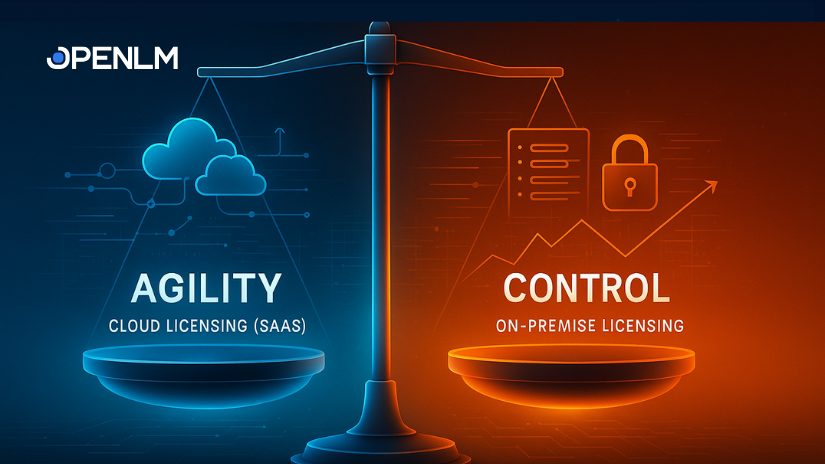
This event forces a necessary strategic discussion: When you license your mission-critical applications through a cloud subscription model (SaaS), you gain immense flexibility, but you must constantly manage the trade-off with the complete, localized control inherent in perpetual licenses. This fundamental choice—Control vs. Convenience—must be proactively managed for true enterprise resilience.
SaaS: The engine of agility and its availability cost
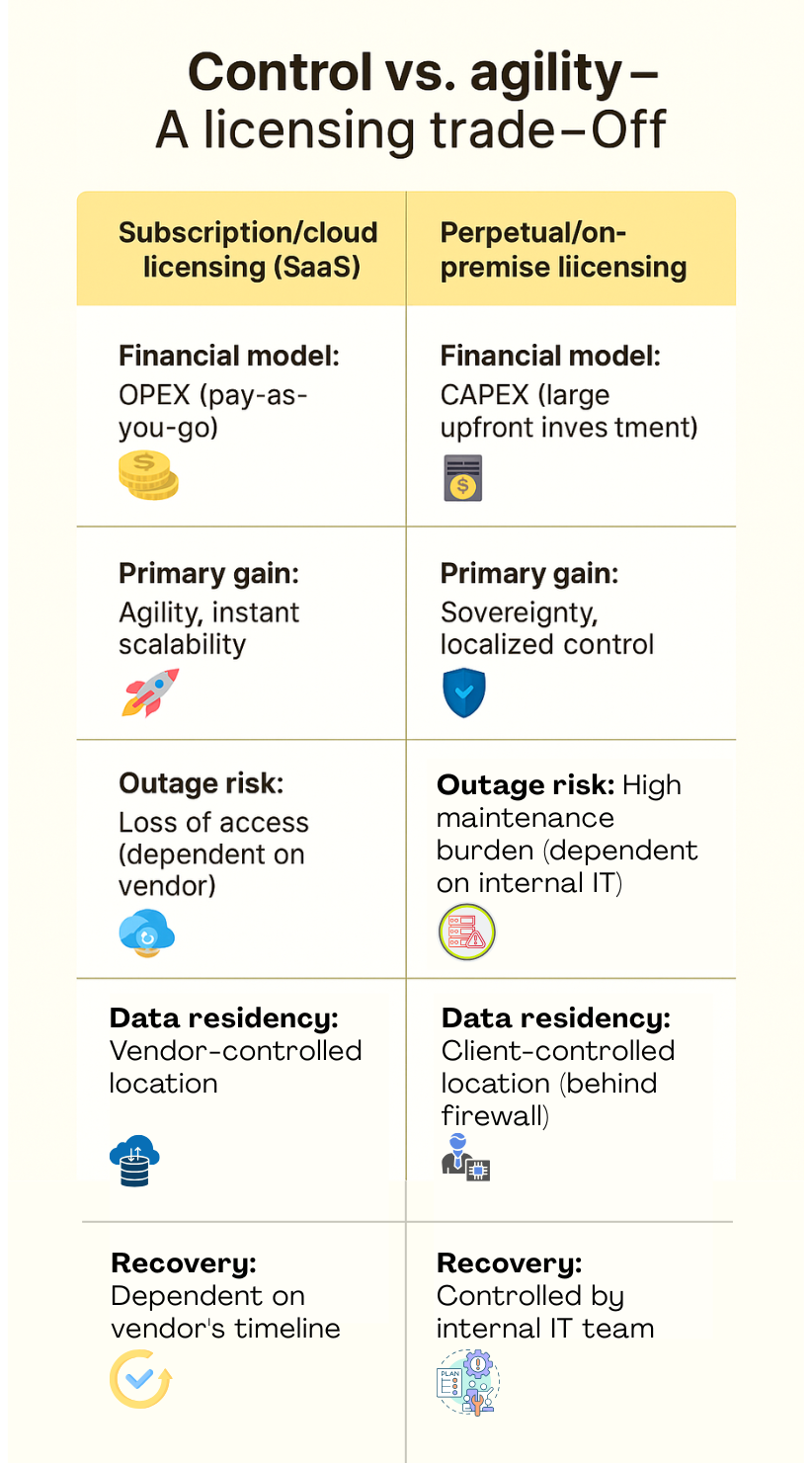
The cloud’s revolutionary value—rapid time-to-market, global scalability, and shifting capital expense (CAPEX) to operating expense (OPEX)—makes it the optimal choice for the vast majority of enterprise workloads. For non-critical, consumer-facing, or elastic applications, the SaaS subscription model is the engine of modern business.
However, the subscription model hinges entirely on continuous, flawless third-party availability. And these third-parties are mostly a handful of global firms like Amazon, Google and Microsoft. When a core service fails—as the DNS resolution issue did in this recent AWS incident, or as seen in the December 2021 AWS outage that took down major services for hours—that seamless access is immediately severed. In a different instance early this year, Microsoft was sued by a global oil refinery company for temporarily revoking their cloud licenses on account of geopolitical tensions. Thus, your cloud license guarantees the right to use the software, but that right is functionally useless if the vendor’s infrastructure is down.
The core consequence is data inaccessibility, leading to severe cloud service disruption impact. Your licensing fee continues to accrue, but your operational capability is zeroed out until a remote third-party resolves the fault. For IT leaders, managing SaaS risks in cloud outages means accepting the unknown, high-impact risk of Vendor Availability Dependence.
Additional Read: The on-premise advantage in a volatile world
Perpetual licensing: Sovereignty at a cost
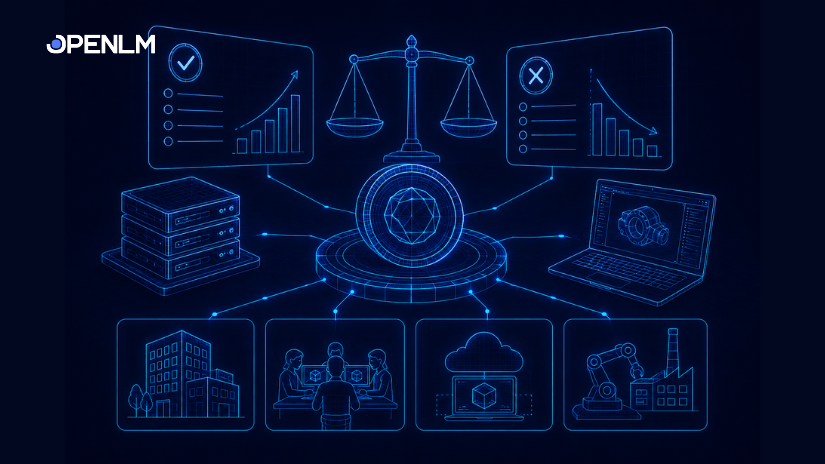
Contrast this with the traditional on-premise or perpetual licensing model. This model grants the software owner absolute control over the environment, which is the ultimate insurance policy against third-party cloud outages such as AWS outage 2025.
With perpetual licensing, the software is deployed on hardware behind your firewall. Your license grants you permanent usage rights to that version of the software. When the wider internet or a public cloud region collapses, your critical data remains accessible via your local network. Your internal IT team, not a remote vendor, is entirely responsible for maintenance, troubleshooting, and recovery.
The trade-off is palpable: this sovereignty demands significant overhead. Perpetual licensing requires high upfront CAPEX for hardware, dedicated staff for 24/7 maintenance and security hardening, and manually managing complex hardware refresh cycles. Scaling up or down is slow and costly, potentially hindering business agility and speed of innovation.
Additional Read: Software license actual usage: Start optimizing with OpenLMA strategic
A strategic mandate for hybrid resilience
The goal isn’t to retreat from the cloud; it’s to deploy intelligently. The repeated failures—from the AWS outage 2025 to previous incidents at major providers—confirm that multi-cloud failure is a matter of when, not if.
For enterprise architects, the conversation needs to move beyond simple cost comparison and focus on workload prioritization. True resilience in the modern enterprise is found in a hybrid licensing strategy:
- Leverage SaaS for everything that needs speed, elasticity, and minimal operational overhead (e.g., development environments, collaboration tools).
- Anchor with perpetual licenses for mission-critical systems where local access, data sovereignty, and the guaranteed ability to act during a wide-scale vendor failure are non-negotiable.
Don’t let the ease of cloud adoption obscure the strategic necessity of control. For your most valuable assets, the power to act—the ability to keep the lights on and the payments flowing when the global web sputters—is the superior resilience model.
Let’s map out a hybrid strategy that minimizes your exposure to third-party availability risk.