You’re paying for 500 Autodesk licenses. But how many of them are actually open right now? How many were used in the last 30 days? How many are sitting idle while your team queues up to access the same tool?
If you can’t answer those questions confidently, you don’t have license usage visibility, and that gap is costing you more than you might think.
What is license usage visibility?
License usage visibility is your ability to see, in real time and over time, exactly how your software licenses are being used across your organization. It tells you who is using what, when, how long, and whether that usage justifies the cost.
Think of it like a utility meter for your software. Without one, you’re paying a flat rate and hoping it’s fair. With one, you see exactly what you’re consuming—and you can act on that data.
For organizations running high-cost engineering and design tools such as Autodesk, Bentley, ESRI, Ansys, and others, this visibility isn’t a nice-to-have. It’s a financial imperative.
Why most organizations are flying blind
The challenge isn’t that organizations don’t care about license usage. It’s that the data is scattered, inconsistent, and hard to act on.
Here’s the situation most IT asset managers and software asset managers find themselves in:
- Multiple license managers, no single view. You might run FlexNet for some tools, Sentinel for others, and a handful of SaaS portals on top of that. Each one speaks its own language.
- Spreadsheet-based tracking. License inventories living in Excel files get stale fast. By the time someone updates the sheet, the data is already weeks old.
- No usage context. Knowing you have 200 licenses is not the same as knowing 140 of them haven’t been touched in 90 days.
- Audit anxiety. Without accurate usage records, every vendor audit becomes a guessing game with significant financial exposure.
The result is a cycle of over-purchasing to stay safe, overpaying on renewals, and still dealing with access bottlenecks.
Additional Read: Preparing for a software license audit: Steps, tools, and best practices
What you lose without license usage visibility
The costs of poor visibility aren’t always obvious on a single invoice. They accumulate.
Wasted spend on unused licenses
Unused and underused licenses are the most direct cost. You pay the full contract price for licenses that deliver zero value. In large enterprises with hundreds of engineering seats, this can mean hundreds of thousands of dollars in annual waste.
Missed downsizing opportunities
When renewal season arrives, you need data to negotiate. Without usage history, you either renew at the same volume (and likely overpay) or risk under-licensing and triggering compliance issues.
Denied access and lost productivity
Visibility works both ways. Without usage data, it’s also easy to under-allocate. Engineers queue for tools, projects stall, and IT teams scramble to troubleshoot access issues that better planning could have prevented.
Compliance risk
Vendors audit. When they do, you need clean, defensible records. Usage logs, peak demand reports, and license allocation histories are your evidence. Without them, you’re negotiating from a weak position.
Poor decision-making at renewal
Should you renew the same number of seats? Switch to a different licensing model? Consolidate vendors? These are strategic decisions that require usage data. Without it, you’re guessing.
What good license usage visibility looks like
Achieving real license usage visibility means more than pulling a report once a quarter. It means having a continuous, structured view of usage that supports both operational and strategic decisions.
Here’s what that looks like in practice:
Real-time usage monitoring
You can see, at any given moment, how many licenses are checked out, who holds them, and how long they’ve been in use. This helps IT teams respond to access issues quickly and gives managers an accurate picture of demand.
Historical usage trends
You can look back across weeks, months, and years to identify patterns. Which tools peak at quarter-end? Which user groups consistently need more access? Which licenses have never been touched?
Denial and queue tracking
When users can’t access a license, that denial should be recorded. Queuing data tells you exactly where bottlenecks exist—and what to do about them at renewal.
User-level and project-level reporting
Visibility at the aggregate level is useful. Visibility at the individual or project level is powerful. You can see which teams drive usage, which cost centers should absorb license costs, and which projects are consuming disproportionate resources.
Cross-tool, cross-manager consolidation
Your software estate doesn’t run on one license manager. Real visibility means aggregating data across FlexNet, Sentinel, DSLS, LM-X, and more—into a single, normalized view.
Additional Read: OpenLM MCP Connector: How to query your software license data with AI
How OpenLM delivers license usage visibility
OpenLM is built around the premise that you can’t manage what you can’t see.
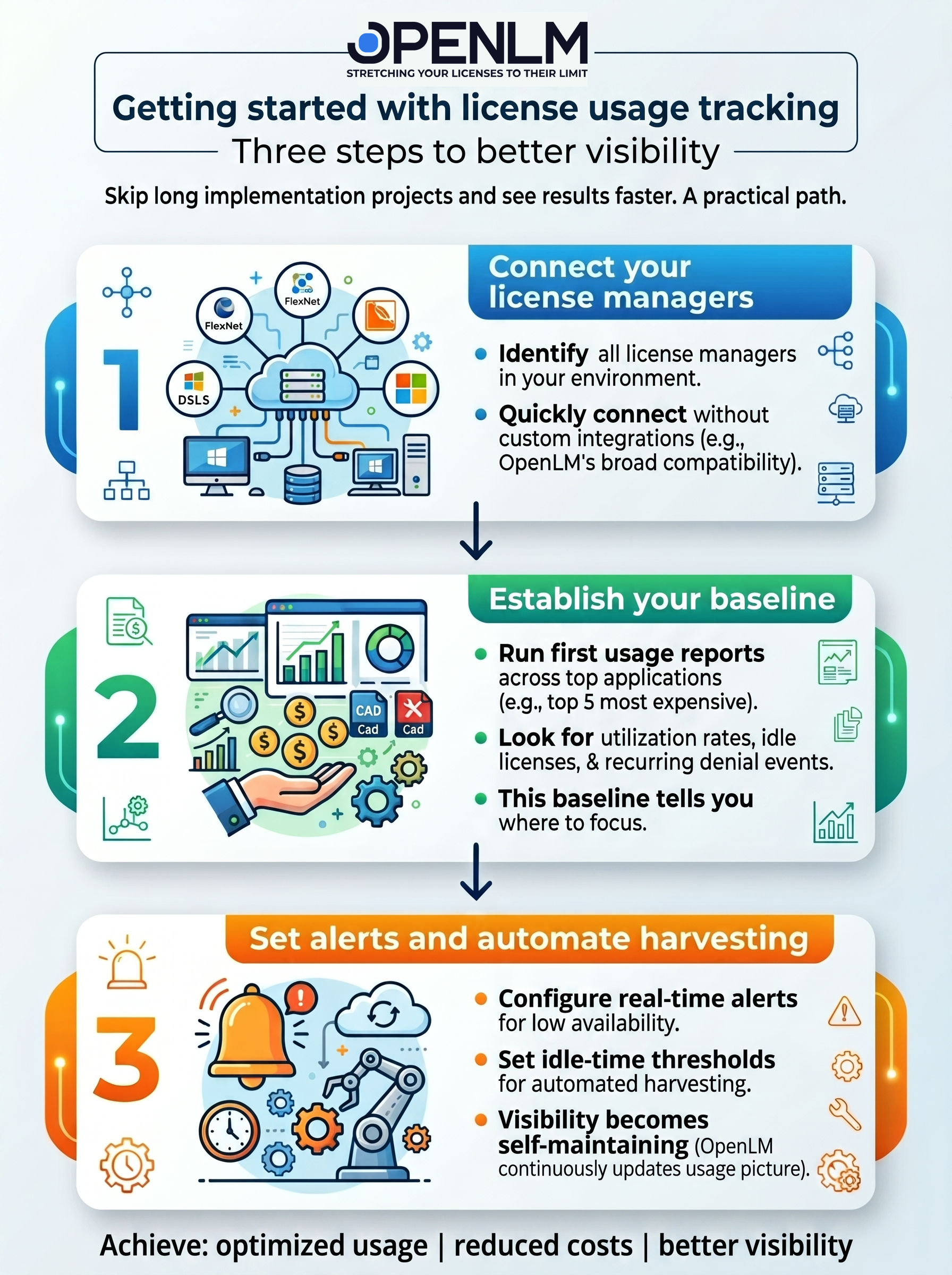
OpenLM connects to 90+ engineering license managers, more than any other solution on the market—giving you a unified view across your entire software estate. With such extensive support, OpenLM is purpose-built for the industries where license costs are highest and usage patterns are most complex.
Here’s how OpenLM helps you achieve true license usage visibility:
Centralized monitoring dashboard
OpenLM aggregates usage data from all your connected license managers into one place. You see real-time checkouts, license availability, and active users—without switching between tools or exporting spreadsheets.
Automated usage reports
OpenLM generates scheduled reports on usage trends, peak demand, idle licenses, and denial events. You can send these directly to stakeholders, so everyone from IT to finance has the data they need, on time, without manual effort.
License harvesting
When a license is idle—say, a user has checked it out but hasn’t actively used it for a defined period—OpenLM can automatically reclaim it and return it to the pool. This reduces wait times and maximizes the value of every seat you’ve purchased.
Trend analysis for renewal planning
Before your next renewal, OpenLM gives you a usage history you can actually act on. You see your true peak demand, your average utilization, and your idle rate—so you can negotiate from a position of knowledge, not guesswork.
Chargeback and cost allocation
OpenLM helps you assign license costs to the teams and projects that drive usage. This makes license spend visible not just to IT, but to the business units responsible for it—creating accountability and smarter consumption habits.
A practical analogy: the fleet GPS tracker
Before GPS tracking, fleet managers ran on guesswork. They knew how many vehicles they owned, but not where those vehicles were, how long they sat idle, or which routes were inefficient. Fuel costs climbed. Vehicles went underutilized. And at the end of every month, the numbers never quite added up.
GPS tracking changed that. Suddenly, fleet managers could see every vehicle in real time—which ones were moving, which ones had been parked for three days, and which routes were burning unnecessary fuel. That data didn’t just reduce costs. It changed how managers made decisions about their entire fleet.
License usage visibility works the same way. Your software licenses are your fleet. OpenLM is the GPS tracker. You see exactly which licenses are active, which are sitting idle, and where demand is building—so you can make smarter decisions about every seat you own.
The bottom line
License usage visibility isn’t a reporting exercise. It’s the foundation of every smart decision you make about software: what to buy, how much to pay, and how to allocate access.
Without it, you’re managing risk with incomplete information. With it, you gain the control and confidence to optimize your software estate—not just at renewal time, but every day.
OpenLM gives you that visibility, across more tools and license managers than any other solution. And it gives you the context to act on what you see.
Frequently asked questions
What is license usage visibility?
License usage visibility refers to your ability to monitor how software licenses are being consumed across your organization—in real time and historically. It shows you who uses which tools, how often, and for how long.
Why is license usage visibility important? Without visibility, organizations routinely overpay for licenses they don’t use, miss opportunities to downsize at renewal, and expose themselves to compliance risk during vendor audits. Visibility turns license data into actionable intelligence.
Which tools does OpenLM support for license usage monitoring?
OpenLM connects to 90+ engineering license managers, including FlexNet/FlexLM, Autodesk, Sentinel RMS, DSLS, LM-X, Reprise License Manager (RLM), and many more.
What is license harvesting, and how does it improve visibility?
License harvesting is the automated process of reclaiming idle licenses—those that are checked out but not actively in use, and returning them to the shared pool. OpenLM monitors activity and reclaims licenses after a configurable idle period, reducing bottlenecks and improving utilization without manual intervention.
How does license usage visibility support vendor audit readiness?
OpenLM maintains detailed usage logs that you can produce during a vendor audit. These records show actual usage patterns, peak demand periods, and user-level allocation—giving you clean, defensible documentation instead of relying on estimates.
How long does it take to set up license usage monitoring with OpenLM?
Setup time varies depending on the size of your environment and the number of license managers you connect. However, because OpenLM supports a wide range of license managers natively, most organizations can begin collecting usage data quickly without custom development.
Can OpenLM show usage by team, project, or cost center?
Yes. OpenLM supports chargeback and cost allocation reporting, which lets you attribute license usage to specific teams, departments, or projects. This helps business units understand their software consumption and supports more informed budgeting decisions.
Is license usage visibility only relevant for large enterprises?
No. Any organization managing multiple high-cost software licenses—whether that’s 50 seats or 5,000—can benefit from usage visibility. The savings and compliance benefits scale with the size of your software estate, but the need for accurate data is universal.
Want to see what your license usage actually looks like? Connect with the OpenLM team for a demo tailored to your environment.