In today’s world, engineering is borderless. A project might be designed in Munich, reviewed in Bangalore, and simulated on a cloud server in Virginia. However, while our talent is global, our software licenses are often stuck in the 1990s—chained to specific geographic coordinates.
For any Software Asset Manager (SAM) or IT Director, understanding the “Geographic License Gap” is the difference between a streamlined budget and a multi-million dollar audit fine.
The “Global License Tax”
Software vendors (like Autodesk, Dassault Systèmes, or Ansys) typically offer three tiers of geographic freedom:
- Single Site: Use is restricted to a physical office or a 50-mile radius.
- Regional/Continental: Use is allowed within a specific region (e.g., EMEA, AMER, APAC).
- Global: Use is allowed anywhere in the world.
The price delta is staggering. A “Global” license can cost 2x to 4x more than a “Single Site” license. Historically, vendors offered significantly lower prices in “Low-Cost Economies” (LCE) to encourage adoption. While vendors are moving toward “Global Pricing” to close this arbitrage gap, the geographic restrictions remain. Even if the price is the same, using a “German” license in “China” is still a breach of contract.
The Compliance Gap: “Smart” Engineers and Travelers
Compliance failures usually happen in two ways:
1. The “Smart” Engineer Bypass
Engineers are problem solvers. If a local license server is full, they may know the IP address of a server in a different region. They point their machine to that remote server and pull a license. Technically, it works; legally, it is a breach.
2. The Traveling Engineer Paradox
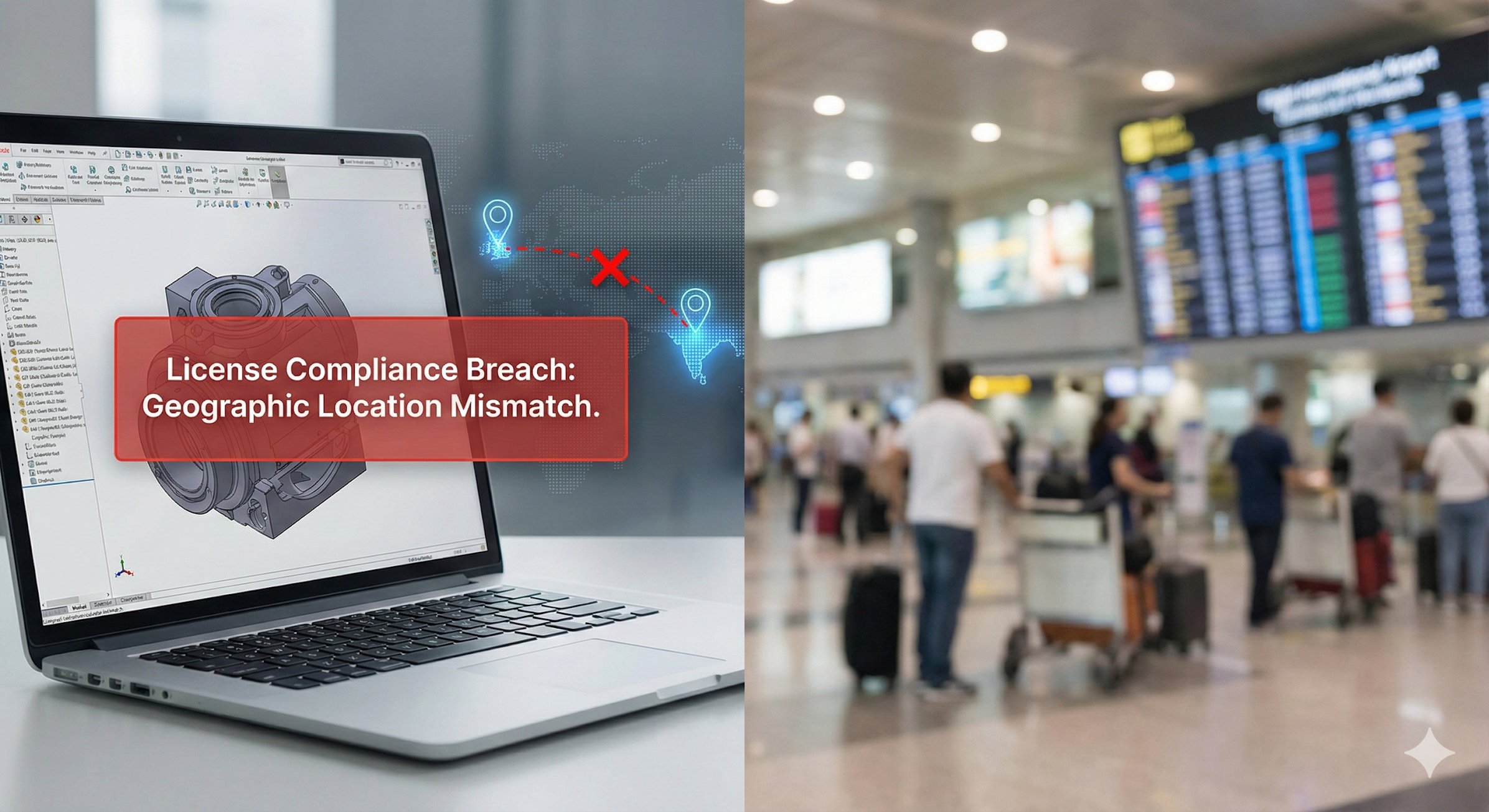
An engineer based in India travels to the UK for a meeting. They connect to the UK office Wi-Fi and pull a license from their home server in India. In the eyes of most EULAs, that license is being “consumed” in the UK. Without a “Global” or “Travel” entitlement, the company is non-compliant.
How to Impose Compliance: Proactive vs. Reactive
A. The Proactive Approach: Automated Enforcement (Prevention)
This method stops the breach before it happens. While manual Options Files are the traditional route, they are notoriously difficult to maintain.
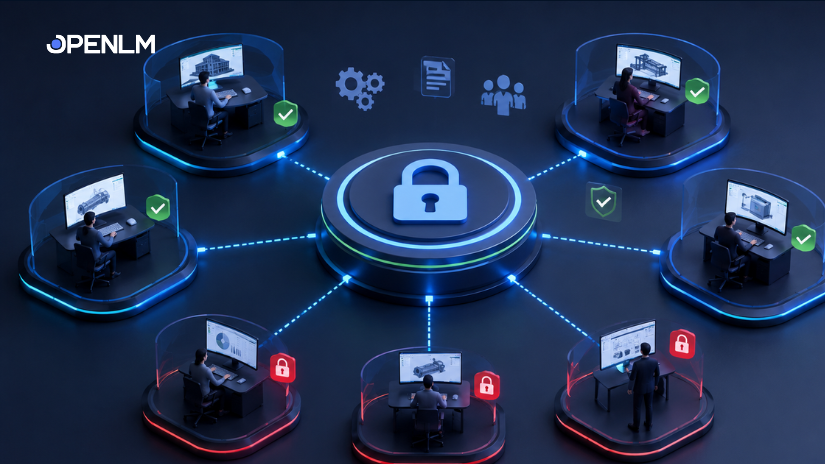
At OpenLM, we solve this with OpenLM LAC (License Access Control).
- How it works: Instead of manually editing text files, LAC allows you to define restrictions and access allowances based on your existing Directory Services (Active Directory/LDAP).
- The Benefit: You don’t need to manage it manually. If a user is moved from the “India” OU to the “Europe” OU in your directory, their license access permissions update automatically.
- Pros: It is nearly impossible to accidentally breach the contract; compliance is “baked into” your infrastructure.
B. The Reactive Approach: Monitoring and Auditing (Transparency)
This method prioritizes flexibility but requires high-quality data to respond to breaches in real-time.
- How it works: You allow open access but use OpenLM to track the workstation IP and the user’s physical location in real-time.
- IP-to-Location Mapping: OpenLM maps workstation IP addresses to specific physical sites. If a license from the “Paris” pool is taken by an IP in “Tokyo,” the system flags it immediately.
- Automated Alerts: You can define specific “Geographic Breach” alerts. When a cross-border usage occurs, IT and the user receive a notification instantly, allowing for an immediate response.
Conclusion: Data vs. Arbitrage
The days of “hiding” usage in low-cost economies are over. Vendors now use sophisticated telemetry to track where their software is running.
In this environment, you have two choices: pay the “Global Tax” for total freedom, or use a combination of OpenLM LAC for automated prevention and IP-to-Location mapping for real-time response.
Does your team know where your licenses are sleeping tonight? If not, it’s time to look at your geographic footprint.