
OpenLM Virtual License Manager (VLM)
License allocation exactly as you need it.
Say goodbye to license conflicts and unavailability. License virtualization gives you the power to create as many virtual license pools as you need, each acting as a real one. Each department in your organization always gets the exact number of licenses allocated to it, in real time, as needed.

What is VLM?
Virtual License Manager (VLM) lets IT managers split the license portfolio of the organization into as many license pools as needed: by department, region or team. You get granular control over license allocation and always keep a set number of licenses available.
A role-based access control system lets IT managers delegate a leader for each virtual license pool, so the work no longer rests on one administrator. No more license conflicts or overwritten settings: with VLM, you keep total control.
Key benefits of VLM
License pool virtualization
VLM creates a virtual representation of the existing license pool structure, so you control the physical implementation.
Delegate license manager roles
Reduce the burden on central IT and delegate license allocation to local team leaders. Decentralize your license portfolio into tenants, which can further allocate or revoke license permissions.
License pool access management
With roles and permissions, central IT manages employee access to the license bucket. You decide who can manage the allocated license pool and who has view-only access.
Avoid management conflicts
Reduce the risk of departments overwriting each other's license allocation. Central IT dedicates a license pool to each department and restricts management access to local team leaders, which removes license management conflicts between departments.
Save time and reduce IT costs
IT administrators no longer manage licenses manually. Departments get more license availability, and license usage stays optimal with the same number of licenses. Keep license costs low and save IT time.
How does VLM work?
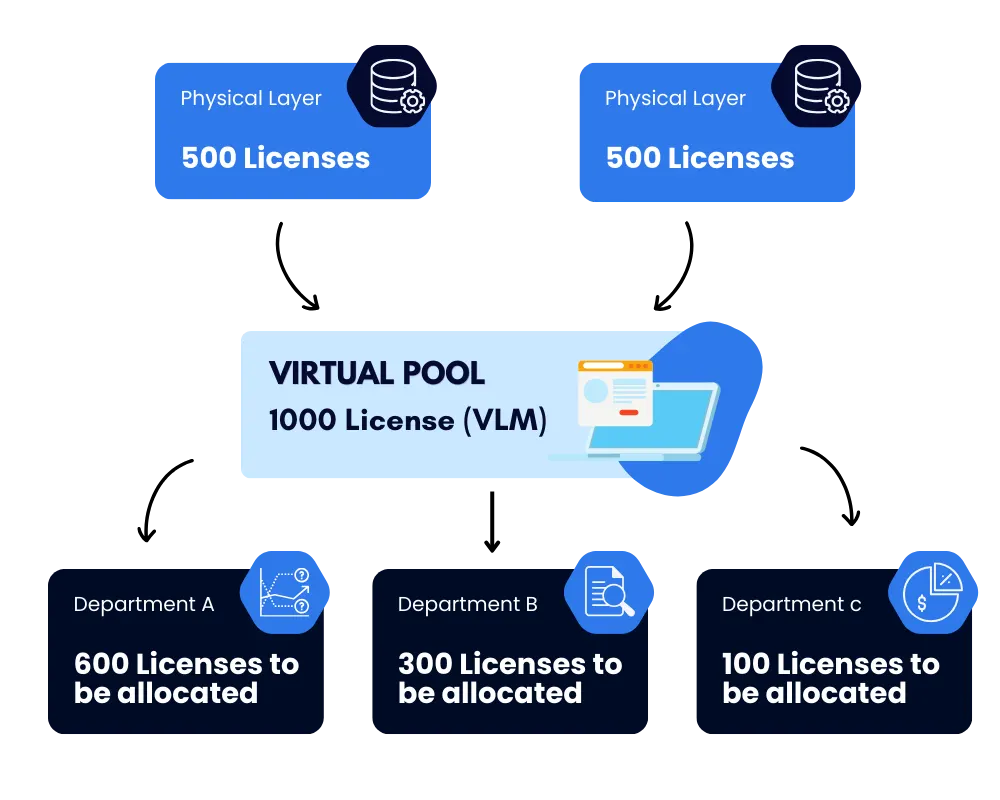
The license managers you already have, with their total combined licenses, are the “physical layer”. VLM creates a virtual layer on top of this physical layer that acts like a real license manager. You can create an unlimited number of virtual license pools and assign licenses dynamically, in real time, according to the needs of a department, group or team. You avoid usage conflicts because you always have the exact number of licenses you need.
For example, two license managers with 500 licenses each form the physical layer. VLM combines them into one virtual pool of 1,000 licenses, which you allocate by department: 600 licenses to department A, 300 to department B and 100 to department C.
VLM gives IT administrators flexible provisioning:
- One interface to consolidate the resources of the organization
- The tools to create unlimited virtual license pools
- Managers assigned to license pools, who grant or revoke licenses as required
Is VLM right for you?
Organizations and IT administrators have long faced complex, unique licensing environments. Usually, this meant managing one or more physical license managers through central IT, or managing many end users from departments spread across the globe. Such systems become harder to run as more environments, departments, groups and teams appear.
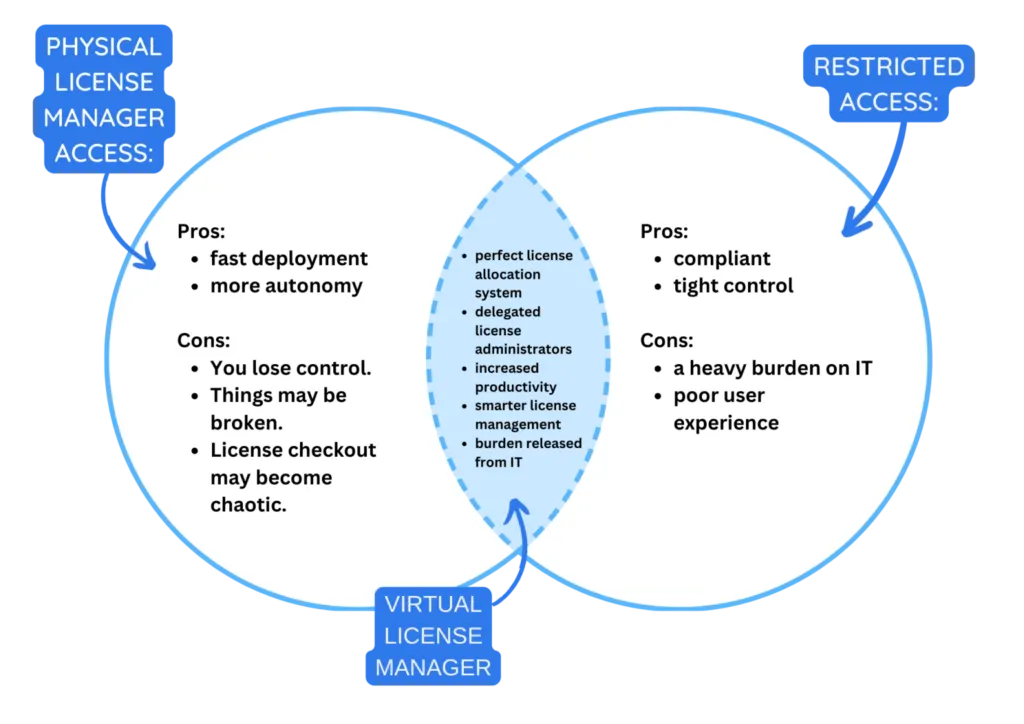
Physical license manager access. Pros: fast deployment and more autonomy. Cons: you lose control, things may break and license checkout may become chaotic.
Restricted access. Pros: compliance and tight control. Cons: a heavy burden on IT and a poor user experience.
Virtual License Manager. Where the two overlap: a precise license allocation system, delegated license administrators, increased productivity, smarter license management and less burden on IT.

Centralized license allocation
In a centralized license allocation environment, the IT team must fulfill requests from many departments or regions for a large number of users. For big organizations, this quickly becomes unmanageable and puts IT under heavy pressure. Allocating licenses to users takes up much of the time of a license administrator, which costs you money.

Decentralized license allocation
In a decentralized model, the IT team grants permissions to departments or team leaders to manage and support their own users. This improves the license allocation workflow, reduces the burden on the central IT team and paves the way for smart license management in a multi-user system.
Frequently asked questions
Is it possible to integrate OpenLM Virtual License Manager with other software solutions?
Yes, Virtual License Manager is compatible with a wide range of software vendors and can integrate with license managers based on FlexNet Embedded.
Can I assign licenses to specific users or groups?
Yes, with Virtual License Manager, you can allocate licenses to specific departments or groups with different rights to reduce the risk of conflicts.
Can local administrators allocate licenses to end users with VLM?
Yes, local administrators can allocate licenses to end users while organizations keep full oversight of their licensing environment with decentralized management.
Testimonials

We soon discovered the discrepancy between the presumed and effective use of the software. Now we know for sure we don’t need to buy more licenses thus saving us a lot of money.

Since we started using OpenLM we now have access to numbers, statistics and reliable information to make decisions and analyze problems and conflicts with licenses on campus. The software is intuitive and works beautifully. Installation and upgrades are a breeze.
Sign up for a free trial
Sign up for a free trial of OpenLM Virtual License Manager today. See how license allocation works across your departments.