For years, software asset management (SAM) lived in the IT department. It was a compliance exercise. You tracked licenses, ran audits, avoided penalties, and renewed contracts. Finance got involved when the invoice arrived.
That model no longer works.
In 2026, engineering software alone — tools like Autodesk, Bentley, ANSYS, and Adobe — commands six- and seven-figure budgets at most mid-to-large enterprises. SaaS sprawl continues to accelerate. Hybrid work has scattered software consumption across geographies, devices, and teams. And procurement cycles that once spanned quarters now move at the speed of a credit card swipe.
The result: organizations are spending more on software licenses than ever before, with less visibility into whether those licenses are actually being used.
That is exactly the problem FinOps was built to solve.
What is FinOps, and how does it relate to software asset management?
FinOps — short for cloud financial operations — started as a framework for managing cloud infrastructure costs. The core idea is simple but powerful: bring engineering, finance, and business teams together to make smarter, faster decisions about technology spend.
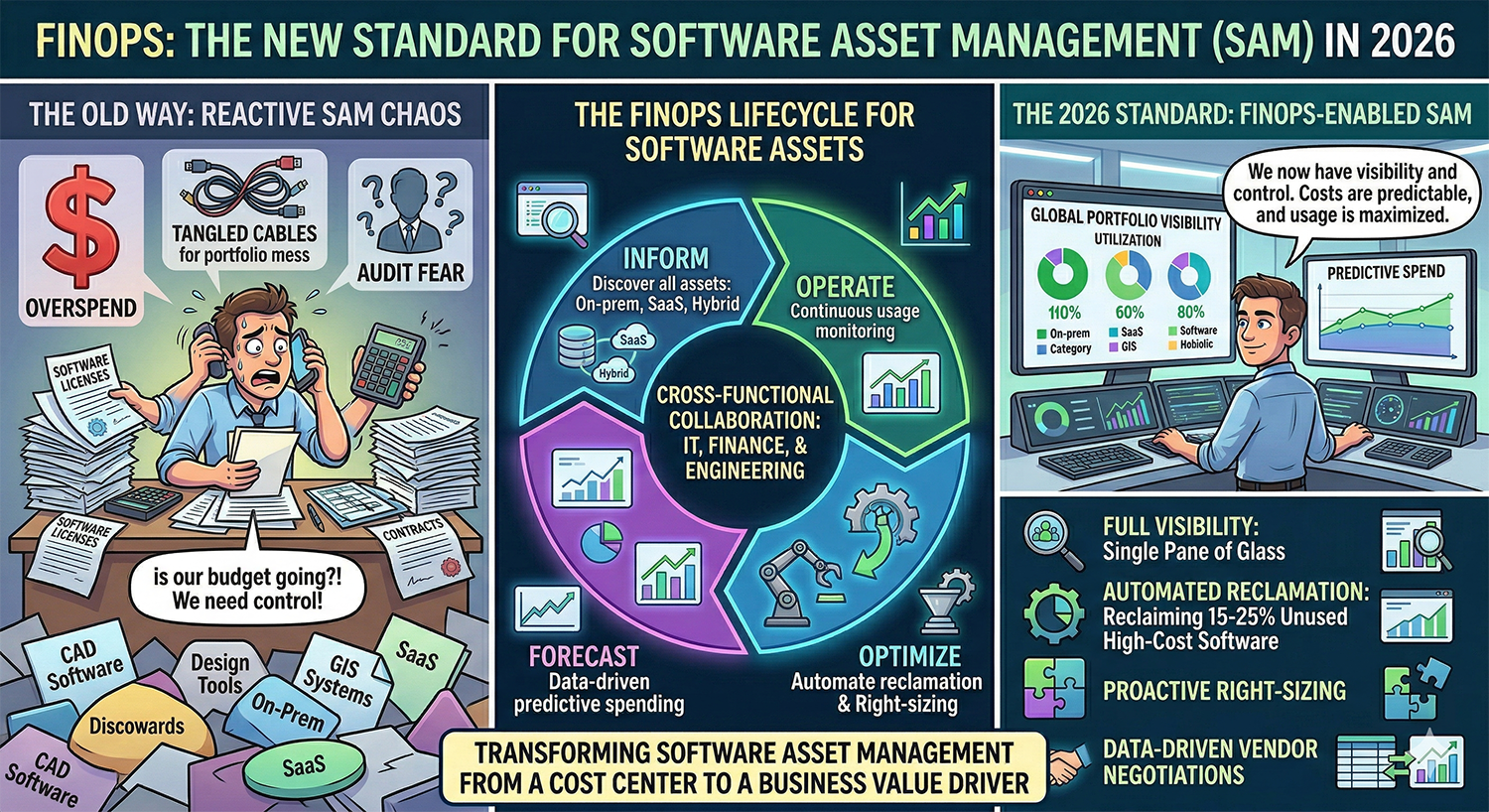
The FinOps Foundation defines the practice around three principles: inform, optimize, and operate. You give teams real-time visibility into costs. You identify waste and right-size consumption. You build financial accountability into everyday operations.
Traditional SAM focused on a narrower problem: license compliance. Do we own enough licenses? Are we over-deployed? Will we pass the audit?
FinOps for software asset management expands that scope. It asks harder, more strategic questions. Are we getting value from what we’ve bought? Where can we reclaim unused licenses? Which teams are consuming the most, and are they budgeted for it? How do we forecast renewal costs accurately?
This shift — from compliance-driven to value-driven — is what makes FinOps the new standard for SAM in 2026.
Additional Read: Simplifying software license management across hybrid IT systems
Why 2026 is the turning point
Several forces have converged to make FinOps-driven SAM not just useful, but essential this year.
Engineering software costs are climbing fast. Vendors like Autodesk and Bentley have accelerated transitions to subscription-based pricing. Per-seat and token-based models have replaced perpetual licenses in many product lines. That means your costs now scale directly with consumption — and consumption that goes unmonitored becomes budget risk.
Remote and hybrid work fragmented license usage. When engineers work across offices, home setups, and regional sites, license consumption patterns become harder to predict and track. Organizations routinely over-purchase to avoid shortages, then discover months later that large portions of their portfolio sit idle.
Finance and IT accountability are converging. CFOs are asking IT to justify every software renewal with usage data. IT leaders who can speak the language of cost allocation, chargeback, and ROI are earning a seat at the table. Those who can’t are losing budget authority.
AI-driven operations demand better data. As organizations layer AI tools on top of existing workflows, the quality of underlying license usage data determines the quality of every forecast, optimization recommendation, and renewal negotiation. Garbage in, garbage out.
FinOps gives software asset management the financial rigor it has always needed but rarely had.
FinOps vs. traditional SAM: what actually changes?
This is worth being direct about, because the difference is meaningful.
Traditional SAM is reactive. You discover license waste after an audit. You renegotiate after renewal. You build reports that tell you what happened last quarter.
FinOps for software asset management is continuous. You monitor usage in real time. You reclaim licenses before they expire. You allocate costs to the teams and projects that generate them — and you use that data to negotiate smarter at renewal.
Here is how the two approaches compare across the dimensions that matter most:
Visibility. Traditional SAM produces periodic snapshots — often quarterly or annual. FinOps produces continuous, real-time dashboards that every stakeholder can act on.
Accountability. Traditional SAM assigns license management to a single IT owner. FinOps distributes financial accountability across departments, so the teams consuming licenses understand what they cost.
Decision speed. Traditional SAM surfaces insights after the fact. FinOps enables decisions before they become expensive mistakes — like reclaiming an idle license before the next billing cycle.
Goal alignment. Traditional SAM optimizes for compliance. FinOps optimizes for value. Those are very different targets.
The bottom line: FinOps does not replace SAM. It elevates it. The discipline, governance, and data rigor of SAM become the foundation for a broader financial management practice.
Additional Read: OpenLM engineering update: Migrating to AWS S3 Tables (Iceberg)
The role of cloud FinOps and SAM integration
One of the most important shifts in enterprise IT is the integration of cloud FinOps and software asset management into a unified operational framework.
For years, cloud cost management and software license management ran on separate tracks — different teams, different tools, different reporting cycles. Cloud costs went to the FinOps team. Software licenses went to SAM. Neither team had full visibility into total technology spend.
That separation is increasingly untenable. Many high-cost engineering applications are now delivered as cloud-hosted or hybrid deployments. The line between a software license and a cloud resource is blurring.
Organizations that integrate cloud FinOps and SAM see clear advantages. They get a single source of truth for technology spend. They can model the full cost of a project — infrastructure plus software — in one view. And they can build chargeback and showback models that accurately reflect consumption across both categories.
This integration is one of the primary reasons FinOps frameworks have expanded well beyond cloud infrastructure. They are now the operating model for managing all high-cost technology assets.
How OpenLM supports FinOps practices
OpenLM supports 130+ license managers — more engineering software licenses than any other solution on the market, with 90+ engineering applications in its portfolio. That breadth is important in the context of FinOps, because it means you get coverage across your most complex, high-cost software environments.
Here is how OpenLM’s capabilities map directly to FinOps principles.
Usage analytics. OpenLM gives you real-time and historical usage data across all your monitored applications. You can see who is using which licenses, when, for how long, and from where. This is the “inform” stage of FinOps — you cannot optimize what you cannot see.
Cost allocation. OpenLM connects license consumption to the teams, projects, and departments that generate it. This enables accurate cost allocation and supports showback and chargeback models — a core FinOps practice that builds financial accountability across the organization.
License reclamation. When licenses go unused beyond a defined threshold, OpenLM identifies them automatically. You can reclaim those licenses and reallocate or return them before they become sunk cost. This is one of the highest-impact optimization levers available in any enterprise software portfolio.
Chargeback reporting. OpenLM generates the reporting infrastructure that finance teams need to implement true chargeback models. Instead of allocating software costs as a flat IT overhead, you can tie costs to the business units and projects that actually consume them — making renewal decisions and budget conversations far more grounded.
ServiceNow integration. OpenLM’s integration with ServiceNow is what connects license management to a full enterprise FinOps workflow. ServiceNow is one of the most widely used platforms for IT service management and financial operations. Through this integration, OpenLM becomes part of an end-to-end FinOps solution — where license data flows directly into asset management, procurement workflows, cost governance processes, and executive dashboards. You are not managing licenses in a silo. You are managing them inside the same operational framework that governs the rest of your enterprise technology.
Additional Read: Shelfware licenses: Identifying and reducing wasted software costs
The benefits of combining FinOps with OpenLM
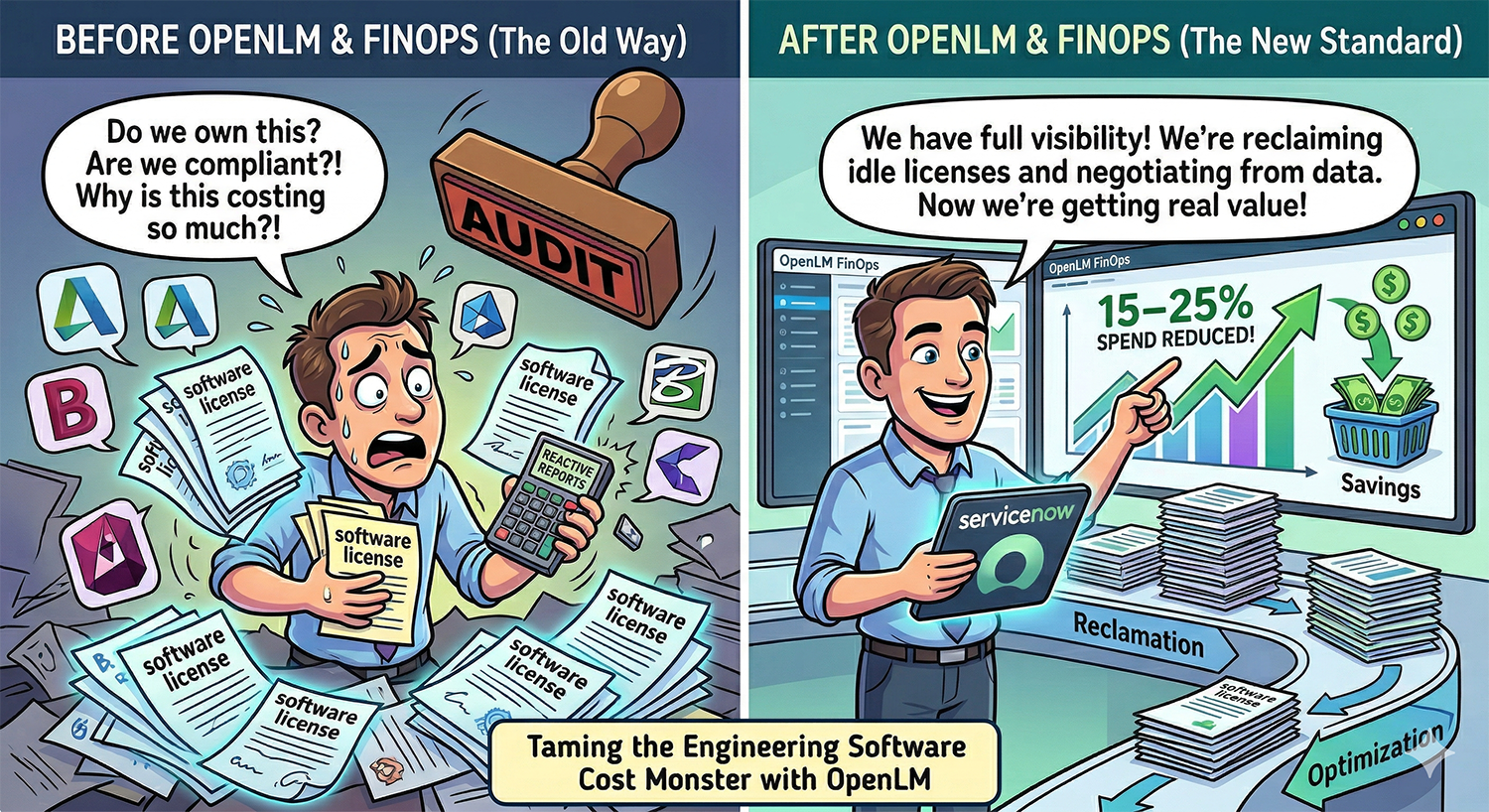
The case for FinOps-driven license management is not theoretical. In most cases, OpenLM customers reduce their engineering software spend by an average of 15–25% within the first year.
That is a meaningful number. On a $1 million engineering software budget, 15–25% represents $150,000 to $250,000 in recovered spend — every year.
Those savings come from several places.
Eliminating idle licenses. Usage analytics surface licenses that are assigned but rarely or never used. Reclaiming them reduces your active license count — and your renewal cost.
Right-sizing renewals. When you go into a renewal negotiation with accurate consumption data, you negotiate from a position of knowledge rather than a position of assumption. You stop buying 20% more than you need “just in case.”
Reducing audit risk. Real-time compliance monitoring means you are always audit-ready. You are not scrambling to reconstruct usage history when a vendor initiates a review.
Aligning budgets to reality. When finance teams can see actual usage data — not estimates — they can build more accurate budgets, reduce over-provisioning, and allocate resources to where they generate the most value.
Beyond cost savings, the operational benefits are significant. Your IT team spends less time on manual license tracking. Your finance team has the data they need for accurate forecasting. And your business leaders have visibility into software spend that was previously opaque.
FinOps best practices for 2026
If you are building or maturing a FinOps practice for software asset management this year, here are the practices that deliver the most impact.
Start with visibility. Before you can optimize, you need accurate usage data. Deploy license monitoring across your highest-cost applications first — typically engineering and design tools. Get a baseline.
Build a license review cadence. Assign ownership of license portfolios to specific teams or managers. Run monthly reviews of usage data. Make reclamation a routine process, not an annual event.
Implement cost allocation early. Even a simple showback model — showing teams what their software consumption costs — changes behavior. Financial visibility drives accountability.
Connect SAM to your ITSM platform. License data is most powerful when it flows into your broader IT operations workflow. Integrating with a platform like ServiceNow means license insights are available where decisions are made.
Use data to lead renewal negotiations. Your next vendor renewal is a financial negotiation. Show up with 12 months of usage data, peak and average consumption trends, and a clear picture of what you actually need.
Automate where possible. Manual processes do not scale. Automated license reclamation, usage alerts, and compliance checks free your team to focus on strategic decisions rather than administrative tasks.
What industries benefit most from FinOps-driven SAM?
Any organization running high-cost specialty software at scale benefits from FinOps-driven license management. But the impact is highest in industries where engineering software dominates the technology portfolio.
Architecture, engineering, and construction (AEC). Firms running Autodesk, Bentley, and similar tools across large project teams face enormous license complexity. Consumption spikes during project phases, drops between them. FinOps-driven management lets you scale licenses with project cycles rather than carrying peak capacity year-round.
Manufacturing and product design. CAD, simulation, and PLM tools represent some of the highest per-seat costs in enterprise software. Usage analytics and reclamation practices deliver outsized savings in this environment.
Energy and utilities. Large-scale engineering operations with distributed teams and multi-site deployments benefit from centralized license visibility and cost allocation across business units.
Government and defense contractors. These organizations operate under strict procurement and compliance requirements. FinOps practices support both cost control and audit readiness.
Higher education and research institutions. Research software portfolios are notoriously difficult to track. FinOps-driven SAM brings structure to environments where license usage is highly variable and budget accountability is distributed across departments.
Additional Read: Optimizing Ansys license usage across engineering teams in 2026
How to implement FinOps with OpenLM
Implementing FinOps with OpenLM follows a clear progression.
Step 1: Deploy and connect. Install OpenLM across your license server infrastructure. Connect it to the applications you want to monitor — starting with your highest-cost tools. Configure your ServiceNow integration to bring license data into your ITSM workflow.
Step 2: Establish your baseline. Run usage analytics for your first 30–60 days without making changes. Understand your actual consumption patterns, identify peak usage periods, and find your first batch of idle or underused licenses.
Step 3: Implement cost allocation. Map license consumption to your organizational structure — teams, departments, projects, or cost centers. Build your showback or chargeback model based on real usage data.
Step 4: Activate reclamation. Configure automated reclamation rules for licenses that fall below your usage threshold. Define the policies, test them, and let OpenLM handle the operational execution.
Step 5: Integrate with your renewal cycle. Before your next major renewal, pull 12 months of usage reports from OpenLM. Identify where you are over-licensed, where you are at risk of under-licensing, and what you actually need going forward.
Step 6: Operationalize and iterate. FinOps is not a one-time project. Build it into your operational cadence — monthly reviews, quarterly reporting to finance, and annual strategy sessions that use license data to inform technology investment decisions.
The bottom line
FinOps for software asset management is not a trend. It is the operating model that enterprise organizations need to manage the growing complexity and cost of their software portfolios.
The shift is already happening. Finance and IT leaders who adopt this framework are reducing costs, improving accountability, and going into vendor negotiations with data rather than guesswork. Those who do not are leaving significant value on the table — and taking on unnecessary budget risk.
OpenLM gives you the usage analytics, cost allocation, license reclamation, chargeback reporting, and ServiceNow integration to make FinOps real — not just as a philosophy, but as a daily operational practice.
Ready to see what FinOps-driven license management looks like in your environment? Request a demo and discover how OpenLM customers reduce engineering software spend by 15–25% in their first year.
Frequently asked questions
What is FinOps and how does it relate to software asset management?
FinOps is a financial operations framework that brings together engineering, finance, and business teams to manage technology spend more effectively. It originated in cloud cost management and has expanded to cover all high-cost technology assets, including software licenses. In the context of software asset management, FinOps adds continuous visibility, cost accountability, and optimization disciplines to a practice that was traditionally focused on compliance.
Why is FinOps becoming the new standard for SAM in 2026?
Several factors have converged: engineering software vendors have moved to consumption-based pricing, hybrid work has fragmented license usage, and finance teams now expect IT to justify software spend with real usage data. FinOps provides the framework to address all of these challenges — making it the natural evolution of software asset management for modern enterprises.
What are the key differences between FinOps and traditional cost management?
Traditional cost management focuses on controlling spend after the fact — audits, renewals, and budget reviews. FinOps is continuous and proactive. It gives teams real-time visibility into consumption, distributes financial accountability across departments, and enables optimization decisions before they become expensive mistakes.
How does OpenLM support FinOps practices?
OpenLM supports FinOps through four core capabilities: usage analytics that provide real-time license consumption data, cost allocation that maps usage to departments and projects, license reclamation that automatically identifies and recovers idle licenses, and chargeback reporting that enables finance teams to tie software costs to the business units that generate them. Its integration with ServiceNow connects these capabilities to a full enterprise FinOps workflow.
What are the benefits of combining FinOps with OpenLM?
The most direct benefit is cost reduction — OpenLM customers reduce engineering software spend by an average of 15–25% within the first year. Beyond savings, organizations gain real-time license visibility, stronger audit readiness, more accurate software budgets, and a data-driven foundation for renewal negotiations.
How can organizations reduce software costs using OpenLM?
OpenLM reduces software costs primarily through license reclamation — automatically identifying licenses that are idle or underused and recovering them before renewal. It also gives procurement and finance teams the consumption data they need to right-size license counts at renewal, rather than over-purchasing as a buffer against uncertainty.
What industries benefit most from FinOps-driven SAM?
Industries that rely heavily on high-cost engineering and design software see the greatest impact. This includes architecture, engineering, and construction; manufacturing and product design; energy and utilities; government and defense contracting; and higher education and research institutions. Any organization running specialty software like Autodesk, Bentley, ANSYS, or Adobe at scale can expect meaningful returns from a FinOps-driven approach.
What is the difference between traditional SAM and FinOps?
Traditional SAM is compliance-focused, periodic, and owned by IT. FinOps is value-focused, continuous, and shared across IT, finance, and business teams. Traditional SAM asks: “Are we licensed correctly?” FinOps asks: “Are we getting value from what we’re spending?”
How do you implement FinOps with OpenLM?
Implementation follows six steps: deploy OpenLM and connect it to your license servers and ServiceNow environment; establish a 30–60 day usage baseline; implement cost allocation by mapping consumption to departments and cost centers; activate automated license reclamation; integrate usage reporting into your renewal cycle; and operationalize the process with regular review cadences. OpenLM’s team supports you through each stage.