There is a familiar pattern in enterprise software management. An organization purchases licenses based on projected need. Usage shifts. Teams grow, shrink, or change tools. New SaaS platforms get adopted outside of formal procurement. And somewhere along the way, the gap between what the organization owns and what it actually uses quietly widens — until an audit, a renewal, or a finance review forces the issue.
By that point, the waste has already compounded. Licenses that sat idle for months have been renewed at full cost. Subscriptions that no one used have rolled over automatically. And the IT team is left trying to reconstruct usage history from incomplete records to justify a budget they had little visibility into.
This is not a niche problem. It is one of the most common and costly inefficiencies in enterprise IT. And in 2026, with engineering software costs rising, SaaS portfolios expanding, and finance teams demanding accountability on every renewal, it is a problem that organizations can no longer afford to manage reactively.
The answer is not more spreadsheets or more frequent audits. It is a smarter approach to license data — one that moves through four connected stages: visibility, insight, automation, and continuous savings. This is the foundation of software license optimization automation, and it is how modern IT teams are turning passive license data into an active cost control mechanism.
Stage one: Visibility — you cannot optimize what you cannot see
Every cost optimization journey begins in the same place: accurate, real-time data. Yet for many organizations, license visibility is still a periodic exercise. Usage reports get pulled at renewal time. Compliance checks happen before audits. And in between, licenses accumulate, get forgotten, or go idle without anyone noticing.
The first stage of software license optimization automation is replacing that episodic view with continuous, real-time monitoring.
Real-time usage analytics give you a live picture of license consumption across your entire software portfolio. You can see how many licenses are currently active, how many are idle, which users are consuming the most, and where demand peaks and troughs occur over time. For high-cost engineering applications — tools from vendors like Autodesk, Bentley, ANSYS, or Esri — this level of visibility is not a convenience. It is a financial necessity.
Consider what real-time visibility reveals that periodic reporting misses. A license that appears used in a monthly snapshot may be idle for three weeks out of four. A peak usage event that triggers an emergency license purchase may actually be predictable and manageable with better data. A team that requests additional licenses may already have allocated ones sitting unused elsewhere in the organization.
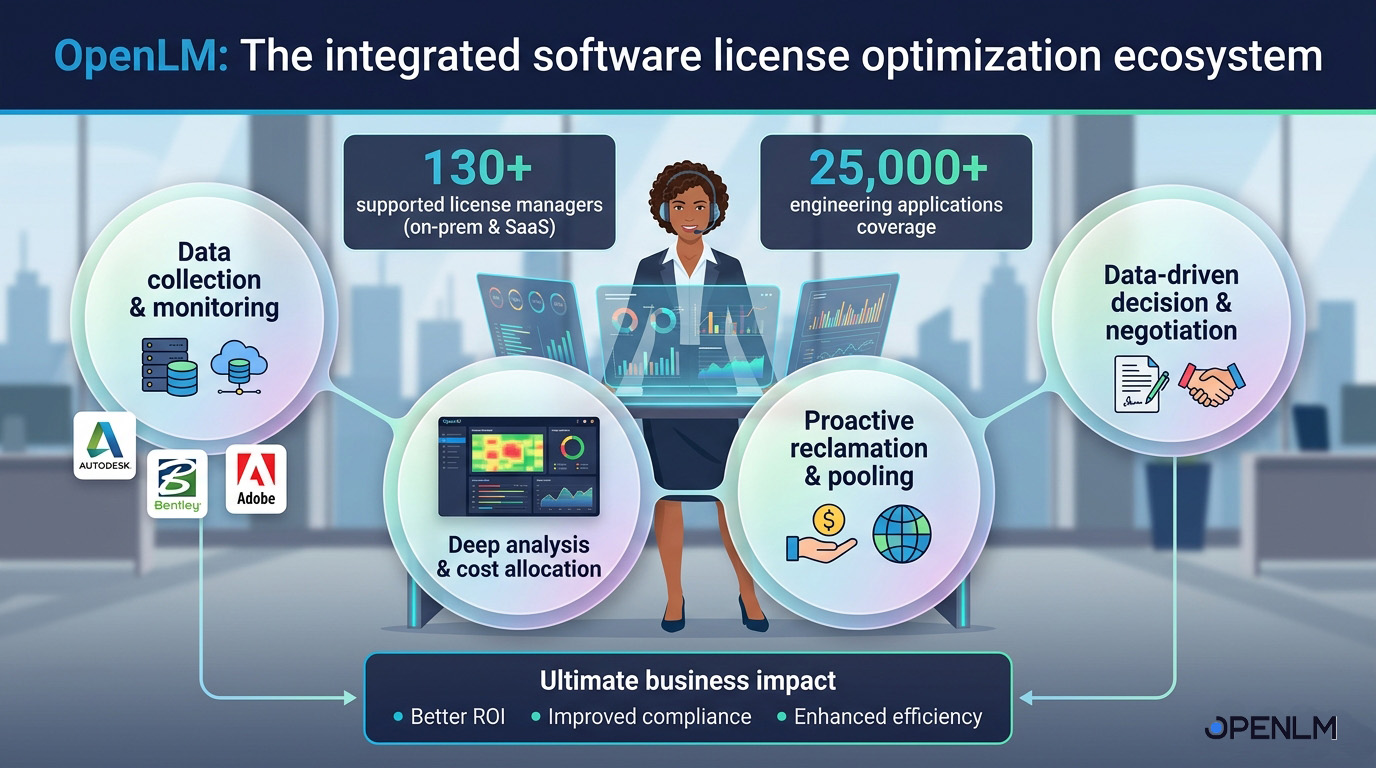
OpenLM provides this foundational layer of visibility across 130+ software publishers, including 90+ license managers for managing engineering applications only. This makes it the broadest engineering software coverage available in any license management platform. Its real-time dashboards surface current and historical usage data, denial events, user-level activity, and consumption trends. For organizations running complex, hybrid license environments, this means a single, unified view across on-premise license servers, cloud-delivered applications, and SaaS platforms.
OpenLM currently monitors approximately 52 SaaS platforms, including Autodesk on cloud and ArcGIS Online from Esri. As major vendors continue their transitions from network-based to cloud-delivered licensing, that unified visibility becomes increasingly important — and increasingly rare among competing platforms.
Visibility is the starting point. But data without interpretation is just noise.
Additional Read: Top license management solutions in 2026: A buyer’s guide for enterprise IT teams
Stage two: Insight — making license data mean something
Raw usage data tells you what is happening. Insight tells you what to do about it.
The second stage of the optimization journey is transforming license data into actionable intelligence. This means connecting consumption patterns to business context — understanding not just who is using what, but what it costs, where that cost belongs, and what it reveals about how your software portfolio can be right-sized.
License utilization insights. Usage analytics become most powerful when they surface underutilization clearly and consistently. OpenLM’s utilization reporting identifies licenses that are consistently idle, infrequently used, or used well below the thresholds that justify their cost. These insights become the basis for reclamation, reallocation, and renewal negotiation — the three levers with the greatest direct impact on software spend.
Cost allocation. One of the most impactful shifts in enterprise software management is connecting license costs to the business units and projects that generate them. When a department sees what its software consumption actually costs — not as an abstracted IT overhead, but as a direct line item — behavior changes. Procurement decisions become more deliberate. License hoarding becomes visible. And the finance conversations around software budgets become grounded in evidence rather than estimation.
OpenLM maps license consumption to departments, teams, projects, and cost centers. This is the data infrastructure that makes both showback and full chargeback models possible — and it is a foundational capability for any organization building a mature FinOps practice.
Chargeback reporting. When license costs are allocated accurately, finance teams have what they need to build reliable software budgets, forecast renewal costs with confidence, and hold business units accountable for their consumption. OpenLM’s chargeback reporting generates the structured output that enables this — feeding into financial planning workflows and, through its ServiceNow integration, into the broader enterprise financial operations environment where budget decisions are made.
Denial event tracking. One of the less obvious but highly valuable insights available through license monitoring is denial event data. When a user requests a license and none is available, that event is recorded. Over time, denial patterns reveal where genuine demand exists — helping IT teams distinguish between licenses that need to be added and licenses that are simply distributed inefficiently across the organization.
This layer of insight transforms license data from a compliance record into a strategic resource. With it, IT and finance teams can make proactive decisions rather than reactive ones.
Stage three: Automation — removing the manual bottleneck
Insight creates the opportunity to act. Automation ensures that action happens consistently, at scale, without requiring manual intervention at every step.
This is where software license optimization automation delivers its most tangible operational value. Manual license management does not scale. As software portfolios grow — more tools, more users, more SaaS platforms, more hybrid deployment models — the human effort required to monitor, reclaim, and optimize licenses manually grows with it. Automation removes that bottleneck.
Automated license reclamation. When a license is idle beyond a defined threshold, OpenLM identifies it automatically and initiates reclamation. The license is returned to the pool for reallocation or flagged for removal before the next renewal cycle. This process — which would require manual review and intervention in a non-automated environment — runs continuously in the background, turning license data into recovered value without demanding IT team bandwidth.
The financial impact of this single capability is significant. Many organizations discover, once automated reclamation is running, that a meaningful portion of their license portfolio is chronically underused. Recovering those licenses before renewal — rather than after — is the difference between right-sized spending and systematic overpayment.
AI-driven subscription optimization. OpenLM’s Subscription Optimizer brings machine learning intelligence to one of the fastest-moving and most expensive areas of enterprise software spend: cloud subscriptions. By analyzing historical usage patterns, the Subscription Optimizer generates recommendations for right-sizing subscription tiers — so you are purchasing what you actually need, not what you estimated you might need at the start of the contract period.
Currently available for Autodesk Cloud and LinkedIn Sales Navigator, with additional SaaS platforms on the roadmap, the Subscription Optimizer represents the evolution of license management from a reporting discipline to a predictive one. Instead of looking backward at what was consumed, it helps you look forward at what should be purchased — closing the loop between license data and procurement decisions.
Process monitoring and idle detection. OpenLM’s process monitoring capabilities track not just license usage, but application and background process activity. When software is running but not actively being used, that idle state is detected and logged. This serves two purposes.
Operationally, it surfaces reclamation opportunities that pure license-level monitoring might miss — situations where a license is technically checked out but the user is not actively working in the application.
From a GreenOps perspective, it provides the data infrastructure for software-level sustainability reporting. Idle applications consume compute resources unnecessarily. Background processes extend device workloads without productive output. For organizations with ESG commitments and sustainability reporting requirements, process-level monitoring contributes directly to the resource efficiency metrics that environmental reporting frameworks increasingly require. Reducing unnecessary software deployments and reclaiming idle processes is not just a cost optimization strategy — it is a measurable contribution to enterprise sustainability objectives.
SaaS cost optimization through continuous monitoring. SaaS licenses present a specific challenge: they are easy to provision, easy to forget, and often billed automatically on renewal regardless of usage. OpenLM’s continuous monitoring of SaaS platforms surfaces underused or unused subscriptions before they roll over — giving IT and finance teams the data they need to make deliberate renewal decisions rather than defaulting to automatic continuation.
Additional Read: The $40,000 blindfold: A CEO’s journey through the AI seat dilemma
Stage four: Continuous savings — making optimization a system, not an event
The final stage is what separates organizations that achieve one-time cost reductions from those that build sustainable, compounding savings over time. It is the shift from treating license optimization as a project to embedding it as an operational discipline.
This is the FinOps principle applied to software asset management: continuous improvement cycles that use real data to inform every procurement, renewal, and allocation decision.
Right-sized renewals. When you approach a vendor renewal with 12 months of usage data — peak consumption, average utilization, denial events, idle rates — you negotiate from a fundamentally different position. You are not buying based on estimates or buffer assumptions. You are buying based on evidence. For high-cost engineering software with significant per-seat or token-based pricing, even modest right-sizing at renewal translates directly into material cost savings.
OpenLM customers achieve an average reduction of 15–25% in engineering software spend within the first year. On a $1 million engineering software budget, that represents $150,000 to $250,000 in annual savings — recovered not through one dramatic intervention, but through the cumulative effect of better visibility, smarter reclamation, and evidence-driven renewals.
FinOps alignment through ServiceNow integration. OpenLM’s integration with ServiceNow connects license management data to the enterprise financial operations workflows where budget decisions live. License usage insights flow into procurement processes, cost governance frameworks, and executive dashboards. IT and finance teams work from the same data. Renewal decisions are informed by consumption evidence. And software spend becomes a managed, accountable line item rather than an opaque overhead allocation.
This integration is what makes OpenLM part of a complete FinOps solution rather than a standalone monitoring tool. It connects the license data layer to the organizational decision-making layer — ensuring that the insights generated by continuous monitoring actually reach the people with authority to act on them.
Building a review cadence. Continuous savings require continuous attention — but automation dramatically reduces the effort involved. With automated reclamation, AI-driven recommendations, and real-time dashboards running in the background, the human effort required shifts from operational execution to strategic oversight. Monthly license reviews become a 30-minute exercise rather than a day-long project. Quarterly reporting to finance draws from live data rather than manually compiled records. And annual renewal negotiations are informed by a full year of usage evidence rather than estimates assembled under deadline pressure.
Additional Read: Simplifying software license management across hybrid IT systems
From data to discipline: The operating model for 2026
In 2026, the organizations managing software costs most effectively are not the ones with the largest IT teams or the most aggressive audit programs. They are the ones that have built license management into a continuous operational discipline — one where visibility, insight, automation, and savings reinforce each other in a loop that compounds over time.
Software license optimization automation is not a single feature or a one-time deployment. It is an operating model. And it requires a platform with the depth, coverage, and integration capabilities to support every stage of the journey — from the first usage report to the last renewal negotiation.
OpenLM provides that foundation. For organizations running complex engineering software portfolios in hybrid on-premise and cloud environments, it offers the deepest coverage, the most actionable analytics, and the automation capabilities needed to turn license data into a sustained competitive and financial advantage.
Ready to start your optimization journey? Request a demo and see how OpenLM turns your license data into continuous cost savings.
Frequently asked questions
What is software license optimization?
Software license optimization is the process of aligning your software license portfolio with actual usage — eliminating waste, reclaiming idle licenses, right-sizing subscriptions, and ensuring that every dollar spent on software generates proportional value. In modern practice, it combines real-time usage monitoring, cost allocation, and automated reclamation to create a continuous improvement cycle rather than a periodic cleanup exercise.
How can license data reduce software costs?
License data reduces software costs by revealing the gap between what you own and what you actually use. Usage analytics identify idle licenses that can be reclaimed before renewal. Utilization trends inform right-sized purchasing decisions. Historical consumption data strengthens your negotiating position with vendors. Together, these insights turn passive license records into active cost control levers.
What is license data automation?
License data automation refers to the use of automated systems to monitor, analyze, and act on software license usage data without requiring manual intervention at each step. This includes automated reclamation of idle licenses, AI-driven subscription optimization recommendations, continuous compliance monitoring, and the automatic feeding of license data into financial reporting and ITSM workflows.
Why is SaaS license management important?
SaaS licenses are particularly prone to waste because they are easy to provision, often renewed automatically, and distributed across departments without centralized oversight. Without active monitoring, organizations routinely pay for subscriptions that are underused or entirely inactive. SaaS license management provides the visibility needed to make deliberate renewal decisions and eliminate unnecessary spend before it compounds.
How does automation improve cost savings in IT?
Automation improves cost savings by removing the manual bottlenecks that prevent optimization from happening consistently. Without automation, license reclamation requires regular manual review — a process that rarely happens at the frequency needed to prevent waste. With automation, reclamation, compliance monitoring, and usage reporting run continuously in the background, turning optimization from an occasional effort into a permanent operational function.
What tools are used for software asset management?
Leading software asset management tools include OpenLM, Flexera FlexNet Manager, Snow License Manager, Open iT License Analyzer, USU Software Asset Management, and ManageEngine AssetExplorer. For organizations with engineering and specialty software portfolios, OpenLM provides the deepest coverage with support for 90+ engineering license managers and approximately 52 SaaS platforms (including engineering and non-engineering ones).
How can companies identify unused software licenses?
Companies identify unused licenses through continuous usage monitoring that tracks active, idle, and inactive license states in real time. OpenLM’s usage analytics surface licenses that fall below defined utilization thresholds, enabling IT teams to reclaim them before renewal. Process monitoring adds a further layer by detecting applications that are running but not actively used — a distinction that pure license-level monitoring can miss.
What are the benefits of continuous license monitoring?
Continuous license monitoring provides real-time visibility into consumption patterns, enables proactive reclamation of idle licenses, maintains an always-current compliance position, generates the usage history needed for renewal negotiations, and feeds accurate data into financial reporting workflows. The cumulative benefit is a software portfolio that stays right-sized and cost-efficient between renewal cycles — not just at the moment of renewal.
How does license optimization support compliance?
License optimization and compliance are directly connected. Accurate usage monitoring ensures that deployed licenses match purchased entitlements, preventing both over-deployment (compliance risk) and over-purchasing (budget waste). Continuous monitoring means organizations are always audit-ready, with historical usage records available on demand rather than reconstructed under pressure when a vendor initiates a review.
What industries benefit most from license data automation?
Industries with large engineering and specialty software portfolios see the greatest return from license data automation, because the per-seat and per-token costs of tools like Autodesk, Bentley, ANSYS, and Esri make even modest utilization improvements financially significant. This includes architecture, engineering, and construction; manufacturing and product design; energy and utilities; government and defense contracting; and higher education and research institutions. Any enterprise running high-cost, complex software at scale — whether on-premise, cloud, or hybrid — benefits from a continuous, automated approach to license optimization.