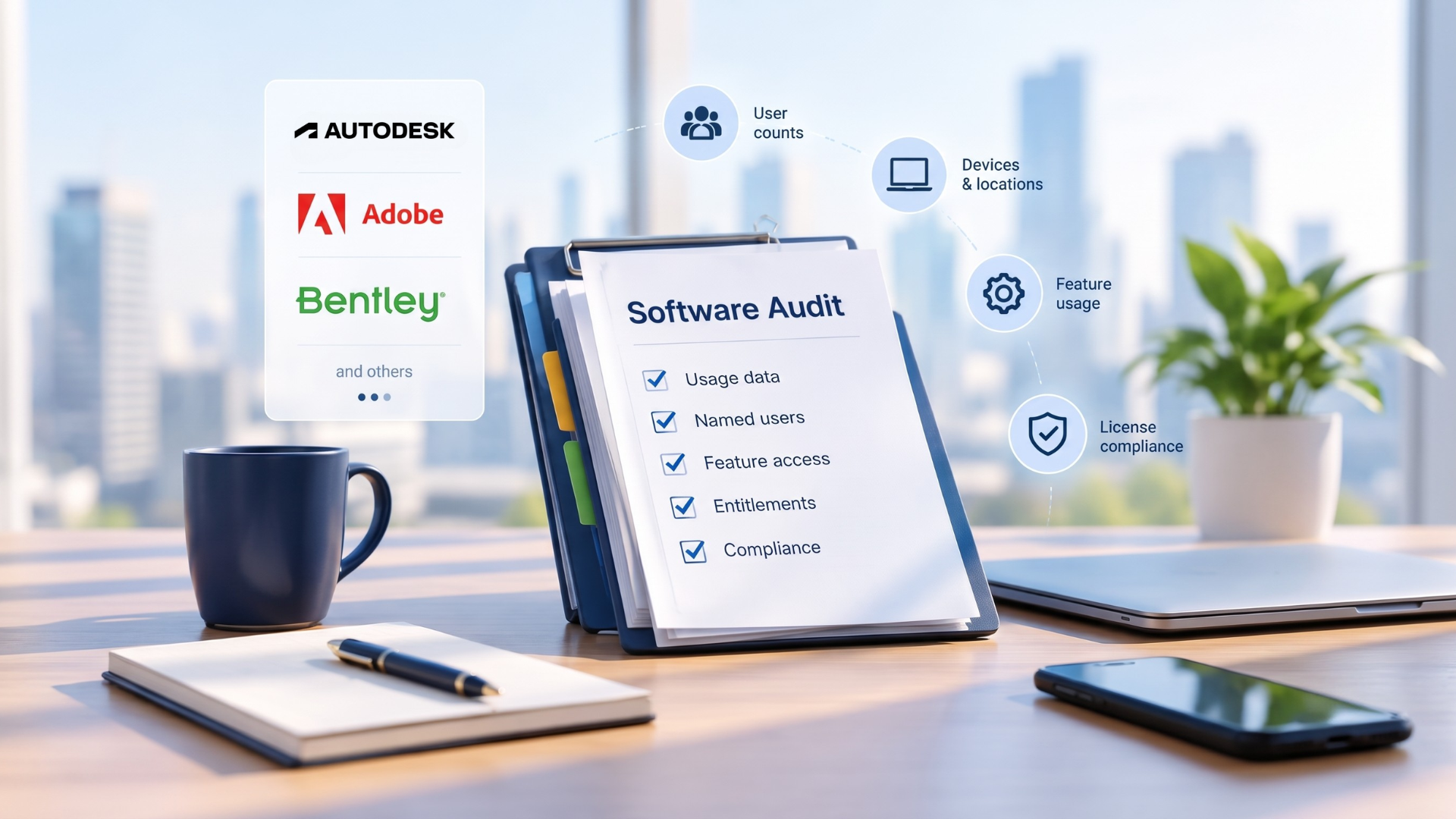
Most advice on software asset management (SAM) best practices assumes every application works the same way: one license, one named user, one renewal date. Specialty engineering tools don’t follow that pattern.
A single Autodesk or Bentley license might serve a dozen engineers across three time zones. A denied checkout at 9 a.m. can stall a project as surely as a lapsed contract.
If you’re managing software assets for an engineering organization, generic IT asset management playbooks don’t quite fit. Floating pools, concurrent seats, and usage-based entitlements need their own set of habits. Here’s how to manage software licenses for specialty engineering tools, in ten practical steps.
Build one real-time inventory across every license manager
Engineering teams rarely run a single license manager. You might have FlexLM entitlements for one CAD platform, RLM for a simulation tool, and a cloud-native scheme for another.
A SAM program that only sees one of those is managing blind. Consolidate usage and entitlement data from every license manager into one view, so you can compare apples to apples across vendors.
Monitor denial rates, not just utilization
Tracking utilization, a crucial parameter in software asset management best practices, tells you how busy a license pool is. It doesn’t tell you how often someone needed a seat and didn’t get one.
A pool at 70% average utilization can still generate daily denials during peak hours. Track denials by application, team, and time of day, and treat a rising denial rate as the signal to act on.
Right-size floating pools to real peak demand
Think of a floating license pool like a shared parking garage. You don’t need one spot per employee. You need enough spots for however many people show up at once.
Size your pools against true peak concurrent demand, measured over weeks rather than a single busy day. Revisit that number whenever a project ramps up or a team grows.
Automate license harvesting for idle sessions
An engineer who opens a license at 8 a.m. and steps away for two hours is still holding that seat. A colleague on the other side of the globe may be getting denied because of it.
License harvesting reclaims seats from sessions idle past a set threshold and returns them to the pool automatically. A crucial capability to consider while implementing SAM best practices for engineering orgs, this alone can shrink the gap between how many seats you own and how many you actually need.
Track usage by project and cost center
Named-user tracking tells you who used what. Project-level tracking tells you what it cost to deliver a program, and which teams are driving demand for your most expensive licenses.
That’s the detail finance needs for accurate chargeback, and the detail you need to defend next year’s budget request with evidence instead of a gut feeling.
Put access rules in place before you need them
Deciding who gets priority access to a scarce, high-cost license is easier to do calmly in advance than in the middle of a deadline crunch.
Define rules for who can check out which license, under what conditions, and in what order of priority. Apply them automatically at checkout rather than relitigating the decision every time demand spikes.
Base renewals on usage data, not last year’s invoice
Specialty engineering licenses renew annually or multi-year, and it’s tempting to just reorder what you had. Pull twelve months of actual concurrent usage and denial history before every renewal conversation.
That history is information vendors don’t volunteer. Bring it to the table, and it strengthens your position on seat counts and pricing alike.
Plan for burst demand with usage-based options
Not every workload is steady. A project that needs double your normal simulation capacity for six weeks doesn’t justify buying permanent seats you’ll barely use the rest of the year.
More vendors are building usage-based and consumption models into their licensing, a shift Esri has been making in its own platform. Weigh a short-term option against a permanent purchase before you default to the familiar one.
Keep a defensible audit trail
Document your license decisions and data sources as you go, not after an audit notice arrives. Cover entitlements, usage history, and who approved what.
That record turns a vendor review from a scramble into a formality.
Review your license strategy every quarter
Teams grow, projects shift, and vendors change their terms more often than a yearly review can keep up with.
Engineering-heavy organizations that align this work with a recognized framework, such as ISO/IEC 19770, tend to find it easier to keep these habits consistent as the environment grows.
Frequently asked questions (FAQs)
What are the most important software asset management best practices for engineering teams?
Start with three: build one inventory across every license manager, monitor denial rates instead of just utilization, and automate license harvesting so idle seats return to the pool on their own. Those three alone surface most of the hidden cost in a floating license environment.
How do you manage software licenses for specialty engineering tools like Autodesk or Bentley?
Treat them differently from standard SaaS seats. They’re usually licensed by concurrent seat, not named user, so you need visibility into real-time checkouts and denials, not just a list of who’s assigned what. Track usage by project, right-size floating pools to peak demand, and bring that data to every renewal.
What’s the difference between software asset management and license optimization?
Software asset management is the broader discipline: inventory, policy, compliance, and renewal processes for every application you own. License optimization is one outcome of following SAM best practices for traditional engineering (floating) licenses, where right-sizing pools and harvesting idle seats can lower cost without buying new seats.
How often should you review your engineering license pools?
Quarterly is a reasonable default. Add a review any time a major project kicks off, a team grows significantly, or a vendor changes its licensing terms. Waiting for the annual renewal cycle usually means reacting to a year of accumulated denials or idle spend instead of catching it early.
What’s the difference between software asset management (SAM) and IT asset management (ITAM)?
ITAM covers every IT asset an organization owns, hardware included. SAM is the software-specific slice of that discipline, and for engineering organizations it has its own sub-focus: concurrent and floating licenses for high-cost, specialty tools. Frameworks like ISO/IEC 19770 treat SAM as a formal part of ITAM rather than a separate practice.