Introduction: The hybrid IT reality
Modern enterprises no longer operate from a single, unified IT environment. Today, most organizations run a mix of on-premises infrastructure, private clouds, public cloud platforms, and remote endpoints — a model commonly known as hybrid IT. While this architecture unlocks flexibility, scalability, and resilience, it introduces one of the most persistent operational headaches in enterprise technology: software license management in hybrid IT.
When software assets are scattered across physical data centers, virtualized environments, SaaS platforms, and remote workstations, keeping tabs on who is using what — and whether they’re licensed to do so — becomes a complex, costly, and compliance-critical challenge.
This blog explores the core challenges organizations face in hybrid IT asset management, practical strategies to address them, and how adopting the right tools can transform license chaos into controlled clarity.
What makes hybrid IT license management so complex?
Traditional software asset management (SAM) was designed around static, on-premises environments. You knew your servers. You knew your endpoints. License counts were reconciled once or twice a year.
That world is gone.
In a hybrid IT environment, software is deployed across:
- On-premises servers and workstations
- Virtual machines and containers (VMware, Hyper-V, Docker, Kubernetes)
- Public cloud instances (AWS, Azure, Google Cloud)
- SaaS applications accessed through browsers
- Remote and BYOD endpoints used by a distributed workforce
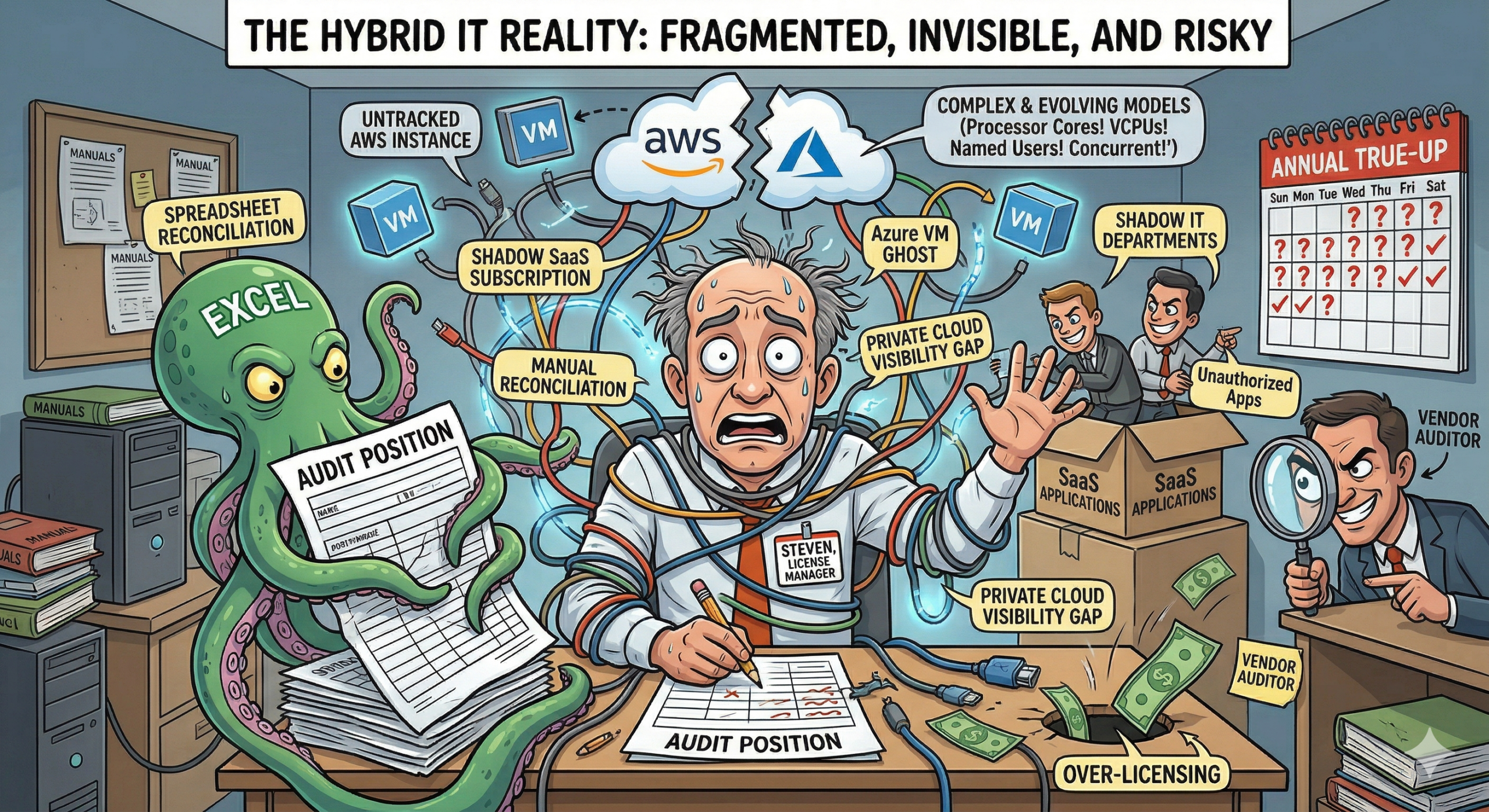
Each of these environments has its own usage patterns, licensing models, and compliance risks. Without a centralized license management system, IT and procurement teams are essentially flying blind — relying on spreadsheets, vendor-supplied reports, or incomplete discovery data.
Additional Read: OpenLM engineering update: Migrating to AWS S3 Tables (Iceberg)
Key challenges in managing licenses across hybrid IT
Visibility gaps
One of the biggest obstacles in hybrid IT asset management solutions is the lack of a single, real-time view of software usage. Cloud instances spin up and down in minutes. Remote workers install applications outside of corporate policy. SaaS subscriptions get provisioned at the departmental level without IT’s knowledge. Each of these activities creates shadow IT — software that’s in use but not tracked.
Without visibility, organizations either over-license (paying for unused software) or under-license (exposing themselves to audit risk and penalties).
Complex and evolving license models
Software vendors — particularly enterprise vendors like Microsoft, Oracle, IBM, and SAP — have continuously evolved their licensing models to account for virtualization, cloud, and multi-user access. License metrics such as processor cores, named users, concurrent users, virtual machine density, and cloud instance types each require different tracking methods.
A single misconfiguration in a virtualized environment can trigger a licensing compliance violation worth millions of dollars in true-up costs. Managing these nuances manually across a hybrid IT landscape is practically impossible.
Audit exposure
Software audits are on the rise. According to industry reports, a significant majority of enterprises are audited by at least one major software vendor in any given three-year period. In hybrid IT environments, the audit risk is amplified because usage data is distributed across multiple platforms, making it difficult to produce a clean and defensible license position on short notice.
This is precisely where license compliance management tools become mission-critical — not just for day-to-day operations, but for audit readiness.
Cost inefficiency
Over-purchasing software licenses is one of the most common — and most overlooked — sources of IT budget waste. When licenses are assigned but rarely used, or when auto-renewals go unchecked across dozens of SaaS tools, the costs accumulate quickly. For large enterprises, the ability to reduce software licensing costs can free up hundreds of thousands — sometimes millions — of dollars annually.
Decentralized procurement and shadow IT
In many organizations, software procurement has become democratized. Business units buy SaaS tools independently. Developers provision cloud software as part of build pipelines. This decentralization makes it nearly impossible for a central IT or SAM team to maintain an accurate, up-to-date inventory using traditional methods.
Software license optimization strategies that actually work
Successfully managing software licenses in a hybrid IT environment requires a shift in both strategy and tooling. Here are the most effective approaches:
Establish a centralized software inventory
Before you can optimize, you need to know what you have. Implementing a centralized license management system — one that integrates discovery agents, cloud APIs, and directory services — gives you a unified view of all deployed software, regardless of where it lives. This is the foundation of any effective software asset management program.
Adopt usage-based license reclamation
Not all assigned licenses are actively used. License reclamation — the process of identifying inactive users and reassigning or deactivating their licenses — is one of the fastest ways to reduce software licensing costs in an enterprise. For organizations running engineering tools, design software, or specialized applications, reclaiming unused concurrent licenses alone can yield significant ROI.
This is a core feature area of modern license management tools: the ability to monitor real-time usage, flag underutilized licenses, and automate reclamation workflows.
Align license models to deployment architectures
Different software license types carry different obligations in virtual and cloud environments. For example, many enterprise applications charge on a per-core or per-processor basis in virtualized environments — and running them on large public cloud instances without proper optimization can dramatically increase license costs.
Working with your IT asset management software to model different deployment architectures against license costs helps procurement teams make smarter buy decisions and reduces the risk of unknowingly triggering compliance violations.
Normalize and reconcile continuously
Rather than annual software audits, best-in-class organizations move to continuous compliance — a model where license positions are reconciled in near real-time against entitlements. This approach surfaces discrepancies quickly, before they compound into audit findings, and keeps the enterprise always prepared for a vendor audit.
Integrate SAM into IT governance and procurement
Software license management shouldn’t be a siloed IT function. The most successful programs connect SAM data directly into procurement workflows, ITSM (IT Service Management) platforms, and financial management systems. This integration ensures that when a new software request is submitted, the license position is automatically factored into the approval process.
Additional Read: Shelfware licenses: Identifying and reducing wasted software costs
The role of license management tools in hybrid IT
Not all license management tools are created equal. Traditional SAM tools were designed for on-premises environments and often struggle to extend coverage to cloud, virtual, and remote contexts. The requirements for effective enterprise license management in a hybrid IT world include:
- Multi-platform discovery: Automated discovery across on-premises, cloud, virtual, and remote endpoints
- Usage metering: Real-time tracking of application usage, concurrent sessions, and idle time
- Entitlement management: Integration with vendor portals, contracts, and ELAs (Enterprise License Agreements)
- Reconciliation reporting: Automated comparison of deployed software vs. owned entitlements
- Audit trail: Full historical usage data for defending against vendor audits
- Integration capabilities: API connectivity with CMDB, ITSM, HR systems, and cloud platforms
When evaluating IT asset management software, organizations should prioritize tools that provide native support for hybrid environments — not those that require separate modules or manual data imports to cover cloud and remote infrastructure.
Best practices for managing software licenses in a hybrid environment
Regardless of the tools you choose, the following practices form the backbone of an effective hybrid IT license management program:
Define ownership and accountability. Assign a dedicated SAM owner or team responsible for maintaining the software inventory, managing entitlements, and liaising with vendors.
Standardize software deployment processes. Work with IT operations to ensure all software deployments — including cloud-provisioned applications — trigger an automatic update to the license inventory.
Right-size licenses at renewal. Use actual usage data from your license management tools to negotiate right-sized contracts at renewal time. Vendors often over-sell capacity; data-driven negotiation helps push back.
Establish a software request portal. Route all software requests through a centralized portal that automatically checks for available licenses before triggering a new purchase.
Train stakeholders beyond IT. Procurement, legal, and finance teams all play roles in software license management. Ensure they understand the compliance obligations associated with software purchases.
Leverage automation wherever possible. The scale of modern hybrid IT environments makes manual tracking untenable. Automation — from discovery to reconciliation to reporting — is not a luxury; it’s a necessity.
Additional Read: The rise of usage-based licensing: What it means for businesses in 2026
How OpenLM simplifies software license management in hybrid IT
Managing software license management in hybrid IT environments requires a platform that is purpose-built for the complexity of modern enterprise IT — and that’s where OpenLM delivers.
OpenLM is a leading IT asset management software and software asset management platform designed to give enterprises complete visibility and control over their specialty software licenses — across on-premises, virtual, cloud, and remote environments.
With OpenLM, organizations can:
- Monitor software usage in real time across all deployment environments
- Reclaim unused licenses automatically, reducing waste and enabling organizations to meaningfully reduce software licensing costs
- Maintain continuous compliance with built-in reconciliation between software usage and license entitlements
- Simplify audit preparation with comprehensive, defensible usage reports
- Integrate seamlessly with existing ITSM, CMDB, and HR platforms through open APIs
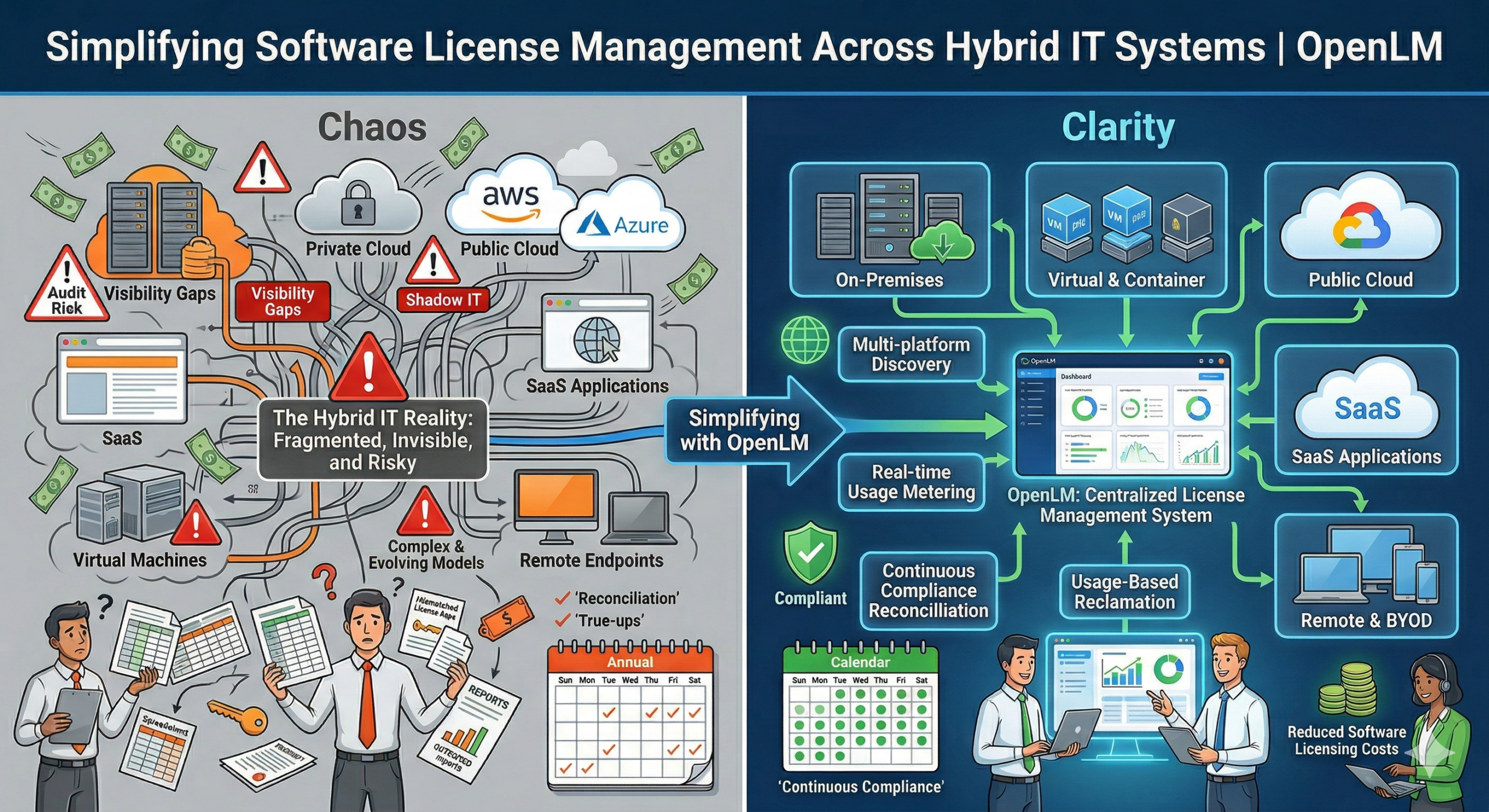
OpenLM’s centralized license management system brings together the data from every corner of your hybrid IT environment into a single dashboard — giving SAM managers, IT directors, and procurement teams the clarity they need to make confident, cost-effective decisions.
Whether you’re managing concurrent engineering licenses for CAD software, named-user licenses for enterprise applications, or SaaS subscriptions spread across departments, OpenLM provides the hybrid IT asset management solutions and software license optimization strategies needed to stay compliant, stay efficient, and stay in control.
Conclusion
Hybrid IT is not a temporary trend — it is the permanent architecture of the modern enterprise. Organizations that continue to rely on outdated, fragmented approaches to software license management will face escalating compliance risks, budget waste, and operational inefficiency.
The path forward is a centralized, automated, and continuously reconciled approach to software asset management — one that covers every corner of the hybrid IT landscape and integrates with the systems your IT and procurement teams already use.
OpenLM is purpose-built for this challenge. With a track record of helping enterprises simplify enterprise license management, reduce licensing costs, and pass software audits with confidence, OpenLM is the platform of choice for organizations serious about taking control of their software estate.
Ready to simplify your software license management across hybrid IT? Explore OpenLM today.
Frequently Asked Questions (FAQs)
What is hybrid IT systems management?
Hybrid IT systems management refers to the practice of overseeing and governing a mixed IT infrastructure that combines on-premises hardware, private cloud environments, public cloud platforms (such as AWS, Azure, or Google Cloud), and remote endpoints. Rather than operating from a single, unified environment, hybrid IT blends multiple deployment models, requiring centralized strategies for monitoring, governance, security, and — critically — software license management.
What is software license management in hybrid IT environments?
Software license management in hybrid IT environments is the process of tracking, controlling, and optimizing software licenses across a distributed and mixed IT infrastructure. It involves discovering all deployed software across on-premises servers, virtual machines, cloud instances, and remote endpoints; reconciling actual usage against owned entitlements; and ensuring the organization remains compliant with vendor license agreements — all from a centralized system.
How does OpenLM help in hybrid IT systems?
OpenLM provides a centralized license management platform that spans on-premises, virtual, cloud, and remote environments. It automates software discovery and usage metering, identifies unused or underutilized licenses for reclamation, reconciles deployed software against entitlements in real time, and generates audit-ready compliance reports. OpenLM integrates with existing ITSM, CMDB, and HR systems, making it a seamless addition to any hybrid IT governance framework.
Why is software license management important for hybrid IT systems?
Software license management is critical in hybrid IT systems for several reasons. First, the distributed nature of hybrid environments creates significant visibility gaps that can lead to over-licensing (wasted spend) or under-licensing (compliance risk and audit exposure). Second, complex vendor licensing models — particularly those involving virtual machines and cloud instances — make compliance difficult to maintain without dedicated tools. Third, rising software audit activity means enterprises must maintain a defensible, accurate license position at all times. Without a robust SAM strategy, the financial and reputational consequences can be severe.
What challenges do companies face in managing licenses across hybrid IT?
Companies managing licenses in hybrid IT environments commonly face the following challenges: lack of centralized visibility across all deployment environments; difficulty tracking software usage on cloud and virtual platforms; complex and frequently changing vendor license models; exposure to software audit risk due to incomplete or inaccurate entitlement data; over-provisioning and unused license waste; shadow IT and decentralized SaaS procurement; and the absence of real-time reconciliation between software deployments and owned licenses.
How can businesses simplify software license management?
Businesses can simplify software license management by: implementing a centralized license management system that discovers and monitors software across all environments; automating license reclamation for unused or inactive assignments; adopting continuous compliance reconciliation rather than annual audits; integrating SAM data with procurement and ITSM workflows; standardizing software request and provisioning processes; and leveraging purpose-built license management tools like OpenLM that are designed for hybrid IT complexity.
What are the best tools for software license management?
The best tools for software license management in hybrid IT environments are those that offer multi-platform discovery (on-premises, cloud, virtual, and remote), real-time usage metering, entitlement management and reconciliation, audit-ready reporting, and integration with existing IT and business systems. OpenLM is widely recognized as one of the leading platforms for enterprise license management, particularly for organizations managing engineering and specialized software licenses in complex hybrid environments.
How can companies reduce software licensing costs?
Companies can reduce software licensing costs through several proven strategies: reclaiming unused or idle licenses and reassigning them rather than purchasing new ones; using real-time usage data to right-size software contracts at renewal; consolidating overlapping tools and eliminating redundant subscriptions; optimizing deployment architectures to minimize per-processor or per-core license exposure in virtualized and cloud environments; and negotiating Enterprise License Agreements (ELAs) based on accurate usage data rather than vendor estimates.
How does OpenLM integrate with existing IT systems?
OpenLM is built with integration at its core. It connects with leading ITSM platforms (such as ServiceNow and Jira Service Management), CMDBs, HR systems, Active Directory, and cloud provider APIs through open, well-documented interfaces. This means usage data from OpenLM flows directly into existing IT governance workflows — enabling automated license requests, provisioning, approvals, and deactivations — without requiring a complete overhaul of existing IT infrastructure.
What are the best practices for managing software licenses in a hybrid environment?
Best practices for managing software licenses in a hybrid IT environment include: establishing a centralized and continuously updated software inventory; assigning clear SAM ownership and accountability within the organization; standardizing and automating software deployment and discovery processes; conducting continuous (rather than annual) license reconciliation; using real-time usage data for renewal negotiations and right-sizing; routing all software requests through a centralized portal with automated license checks; training procurement, legal, and finance stakeholders alongside IT; and leveraging purpose-built SAM and license management tools to automate and scale these practices across the entire hybrid IT estate.