The landscape of software procurement is undergoing a fundamental transformation. In 2026, the shift from fixed-cost models to usage-based licensing is no longer a trend—it is the standard. As you manage increasingly complex tech stacks, the demand for transparency and value-aligned pricing has never been higher.
Understanding the shift to usage-based licensing
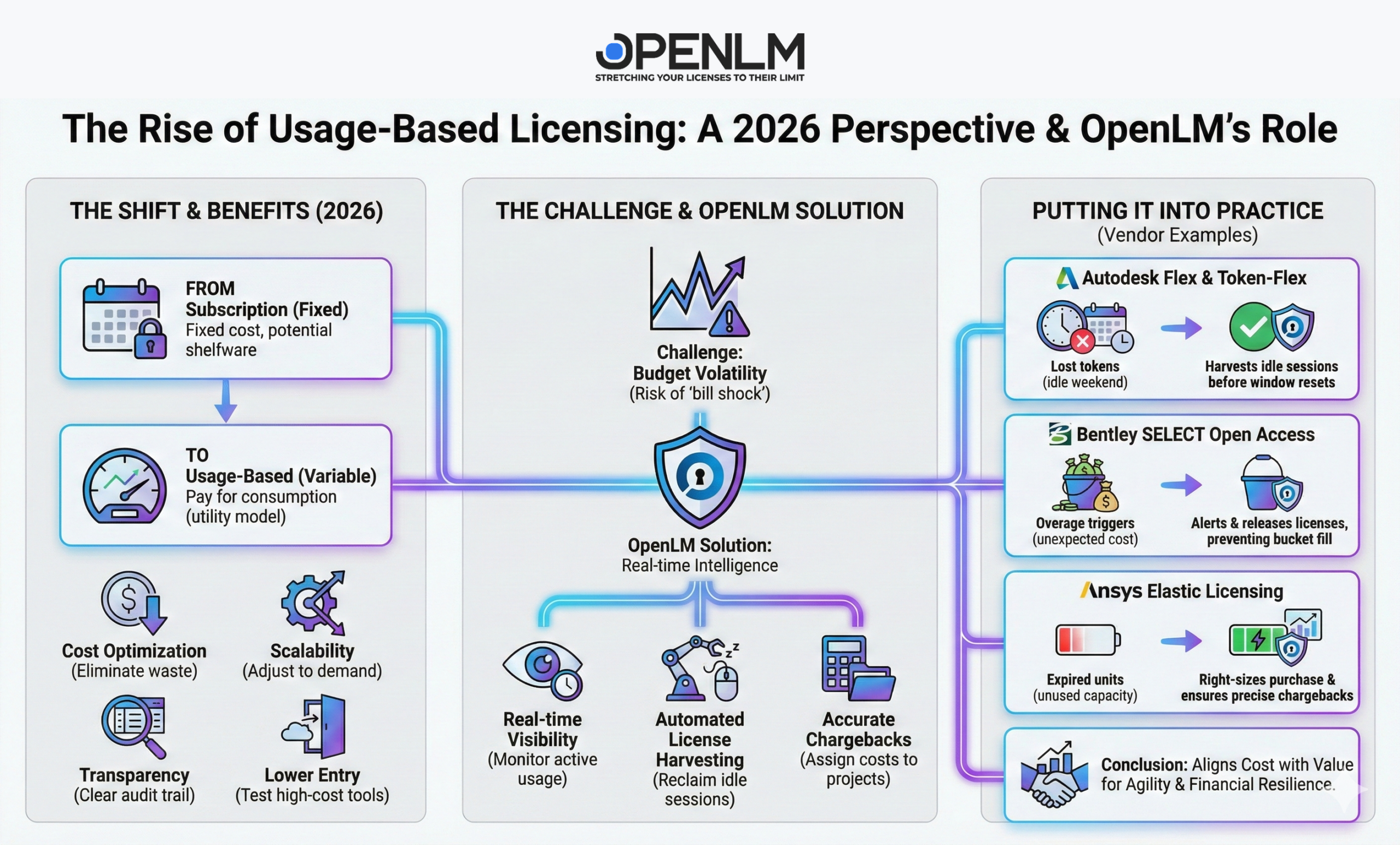
Usage-based software licensing is a model where you pay for software based on actual consumption rather than a fixed number of seats. Think of it like a utility bill. Instead of paying for a “buffet” of features you may not use, you pay for the specific “dishes” your team consumes.
In 2026, the software market is reaching a critical tipping point. Much of the growth in the engineering and specialty software sectors is driven by consumption-based licensing, where charges are tied to measurable indicators like application access time, sessions initiated, or specific feature calls.
Subscription vs. usage-based licensing
While subscription models provided a step forward from perpetual licenses, they often lead to “shelfware”—licenses that you pay for but never use.
| Feature | Subscription Licensing | Usage-Based Licensing |
| Cost Structure | Fixed, recurring fee | Variable, consumption-based |
| Predictability | High budget certainty | High variability without monitoring |
| Scalability | Requires manual seat adjustments | Scales automatically with demand |
| Value Alignment | Pay for access | Pay for outcomes |
Subscription vs usage-based licensing isn’t just a choice of billing; it is a choice of business agility. Subscription models work well for steady, predictable needs. However, usage-based licensing pricing offers the elasticity required for project-based work and fluctuating workloads common in engineering and design.
Additional Read: Specialty software license management: The OpenLM advantage
The benefits of usage-based licensing in 2026
The adoption of metered software licensing provides several strategic advantages for your enterprise:
- Cost optimization: You eliminate waste by only paying for what you use.
- Scalable software licensing models: You can scale your operations up during peak project periods and down during lulls without renegotiating contracts.
- Transparency and trust: Pay-per-use licensing models provide a clear audit trail of exactly how and where your budget is being spent.
- Lower barrier to entry: Cloud usage-based pricing allows you to test high-cost specialty software for small projects without a massive upfront investment.
Navigating the challenges of 2026 usage-based licensing trends
Despite the benefits, usage-based licensing trends 2026 highlight a significant challenge: budget volatility. Without proper oversight, consumption can spike unexpectedly, leading to “bill shock.”
To stay ahead, you need usage tracking software for licensing that provides real-time visibility. You cannot manage what you cannot measure. In 2026, real-time license intelligence has replaced periodic reporting as the primary method for controlling spend.
How OpenLM empowers your transition
OpenLM specializes in monitoring and optimizing high-cost specialty software. We support over 130 license managers across on-premises and SaaS environments. With deep expertise in engineering licenses—supporting more than 90+ specific types—we provide the granular data you need to thrive in a usage-based world.
Real-time visibility
We provide a centralized dashboard that tracks usage across your entire organization. You can see who is using a license, for how long, and which features they are accessing in real-time. This visibility allows you to identify bottlenecks before they impact productivity.
Automated license harvesting
OpenLM identifies idle sessions and automatically reclaims licenses. This ensures that your “meter” isn’t running when no productive work is happening. By closing applications on inactive workstations, you return licenses to the pool for others to use.
Accurate chargebacks
With our project and group usage reporting, you can accurately assign software costs to specific departments or clients. This turns software from a general overhead cost into a manageable, traceable project expense.
Additional Read: Introducing the Broad Peak release of OpenLM: A new era of license management
Putting it into practice: Vendor-specific examples
To see the impact of OpenLM in a usage-based environment, consider how we handle the industry’s most complex models:
- Autodesk Flex and Token-Flex: Autodesk Flex uses a 24-hour token consumption window. If a user leaves an application open over a weekend, you could lose three days’ worth of tokens for zero productivity. OpenLM monitors these windows and uses automated license harvesting to close idle sessions before a new 24-hour period begins, protecting your token pool.
- Bentley SELECT Open Access: Bentley’s Quarterly Term Licensing (QTL) can lead to unexpected invoices if you exceed your pre-set thresholds. OpenLM provides real-time alerts and can automatically release licenses when a workstation hibernates, preventing you from filling an additional “bucket” and incurring overage penalties.
- Ansys Elastic Licensing: Ansys Elastic Currency (AEC) allows for high-burst simulation capacity. However, units typically expire if not used within a year. OpenLM analyzes your historical usage patterns to help you right-size your AEC purchase and ensures that high-cost simulation credits are accurately charged back to the specific departments or projects that initiated the runs.
Conclusion
The rise of usage-based licensing reflects a broader move toward efficiency and accountability. By aligning your costs with the actual value you derive from software, you position your business to be more agile and financially resilient in 2026.
FAQs
What is usage-based licensing?
It is a pricing model where you pay for software based on actual consumption (e.g., time, features, or data processed) rather than a flat fee per user.
How does usage-based licensing work?
Vendors use telemetry to track your activity. They then bill you at the end of a cycle based on the “units” of software you consumed.
What are the benefits of usage-based licensing for businesses?
The primary benefits include reduced waste, better alignment of costs to value, and the ability to scale software access up or down instantly.
What is the difference between subscription and usage-based licensing?
Subscriptions charge a fixed recurring fee for access, while usage-based models charge a variable fee based on actual activity.
Is usage-based licensing suitable for SaaS companies?
Yes. In fact, most SaaS companies in 2026 use a hybrid model combining a base subscription with usage-based tiers for advanced features or high volume.
What industries benefit most from usage-based licensing?
Industries with fluctuating workloads or high-cost specialty tools—such as Architecture, Engineering, & Construction (AEC), manufacturing, and automotive—see the highest ROI.
How does OpenLM support usage-based licensing?
OpenLM provides the tracking and reporting tools necessary to monitor consumption, prevent overspending, and automate license reclamation to keep costs low.
Is OpenLM suitable for organizations transitioning from subscription to usage-based licensing?
Absolutely. We provide the historical data you need to negotiate your new usage-based contracts and the real-time monitoring to manage them once they are active.