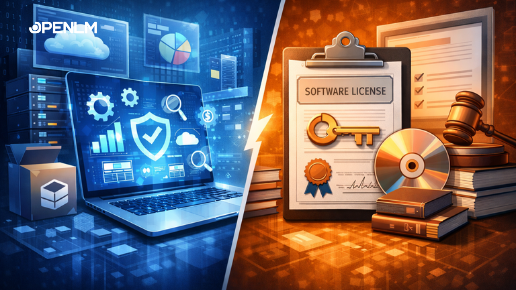
In the world of IT governance, terms are often used interchangeably, leading to confusion. One of the most common mix-ups occurs between software asset management vs license management. While both are critical to a healthy IT ecosystem, they serve different purposes, have different scopes, and deliver different value to an organization.
Are they the same thing? No. Is one part of the other? Yes.
To optimize your IT budget and ensure compliance, it is crucial to understand the differences between SAM and SLM. This guide explores the nuances of SAM vs license tracking, helping you decide which approach—or combination of both—is right for your business.
What is software license management (SLM)?
Software license management (SLM) is the tactical practice of tracking and maintaining your organization’s legal rights to use software. It is primarily focused on managing software licenses to ensure compliance with End User License Agreements (EULAs).
Think of SLM as your defense shield. Its primary goal is to answer the question: “Do we own the licenses for the software we have installed?”
Key functions of license management:
- Compliance and audit defense: ensuring you aren’t using more licenses than you purchased.
- Entitlement tracking: Keeping records of contracts, purchase orders, and license keys.
- Allocation: Assigning specific licenses to specific users or devices.
- Expiration monitoring: Tracking renewal dates to prevent service interruptions.
Note: Without effective SLM, organizations face significant legal risks and hefty fines from vendor audits.
Additional Read: The future of software asset management: Trends to watch in 2026
What is software asset management (SAM)?
Software Asset Management (SAM) is a broader, strategic discipline. It involves managing and optimizing the purchase, deployment, maintenance, utilization, and disposal of software applications within an organization.
While SLM focuses on legality, SAM focuses on lifecycle and value. Software asset management solutions look at the big picture: how software is requested, how it is used (or ignored), and how it impacts the bottom line and security posture.
Key functions of SAM:
- Lifecycle management: Managing software from the initial request to retirement (disposal).
- Cost optimization: Identifying shelf-ware (unused software) and reclaiming licenses to save money.
- Shadow IT dscovery: Finding unauthorized software running on the network.
- Policy and governance: Standardizing what software is allowed to be installed.
- Security: Ensuring all software is patched and free of vulnerabilities.
SAM vs. license management: The core differences
To truly understand software asset management vs license management, it helps to visualize the comparison. SLM is often reactive (responding to audits), while SAM is proactive (optimizing spend).
Here is a breakdown of SAM vs license management differences:
| Feature | Software license management (SLM) | Software asset management (SAM) |
| Primary goal | Compliance and audit defense | ROI, lifecycle efficiency, and security |
| Scope | Narrow: Focuses on legal entitlements | Broad: Focuses on the entire lifecycle |
| Key question | “Are we compliant?” | “Are we efficient and secure?” |
| Time horizon | Tactical (Short-term/Current state) | Strategic (Long-term planning) |
| Data focus | Contracts, keys, installation counts | Usage data, procurement, security risks |
| Outcome | Risk avoidance (avoiding fines) | Value creation (saving money) |
Why you need both: The synergy
It is rarely a case of choosing SAM vs license tracking as an “either/or” scenario. Asset management and licensing are deeply intertwined.
Is license management part of SAM?
Yes. You cannot have a mature SAM program without a solid License Management foundation. If you don’t know what you own (SLM), you cannot optimize it (SAM).
- SLM provides the data: It tells you what you have rights to use.
- SAM provides the intelligence: It tells you if you should be using it, who is using it, and if there is a cheaper alternative.
The risk of doing only one
- SLM without SAM: You might be compliant, but you could be wasting millions on “shelf-ware”—licenses you pay for but nobody uses.
- SAM without SLM: Impossible. You cannot manage assets effectively if you don’t understand the underlying licensing rules.
Additional Read: Esri licensing changes 2026: What to expect
Tools of the trade
To execute this strategy, organizations rely on specialized software.
- License management platforms are often simpler tools or modules within a service desk, focusing on inventory and contract storage. However, an advanced license management solution, such as the OpenLM Platform, offers granular insights for managing specialty software licenses and reducing license waste.
- Software asset management solutions (like ServiceNow SAM) are complex platforms that integrate with your network to discover installed software, measure usage, and automatically reconcile that against your license entitlements.
Conclusion
Understanding software asset management vs license management is the first step toward IT maturity. While license management keeps you out of legal trouble, software asset management ensures you aren’t throwing money away on unused tech. By integrating software license management into a broader SAM strategy (such as opting for the OpenLM ServiceNow integration), you secure not just compliance, but efficiency and cost savings.
Frequently Asked Questions (FAQ)
What is software asset management (SAM)?
Software Asset Management (SAM) is a business practice that involves managing and optimizing the purchase, deployment, maintenance, utilization, and disposal of software applications within an organization. It focuses on cost reduction, risk mitigation, and maximizing the value of IT assets.
What is software license management (SLM)?
Software License Management (SLM) is a subset of SAM focused specifically on tracking and maintaining software license rights. Its primary goal is ensuring legal compliance with vendor agreements to avoid audit fines and legal penalties.
Is license management part of SAM?
Yes, absolutely. License management is a foundational component of SAM. While SLM handles the compliance and entitlement aspect, SAM adds layers of lifecycle management, cost optimization, and usage analysis.
When do you need software asset management?
You need SAM when your organization’s software spend becomes significant, when you are facing frequent vendor audits, or when you suspect you are paying for software that isn’t being used. It is essential for any company scaling its IT infrastructure.
How software asset management reduces license costs?
SAM reduces costs by identifying “shelf-ware” (unused software) so you can cancel unnecessary subscriptions. It also helps in “harvesting” licenses—taking a license from a user who doesn’t use it and giving it to someone who needs it, preventing the purchase of new licenses.
Which is better: SAM or license management?
Neither is “better” as they serve different needs, but SAM is more comprehensive. SAM provides greater business value because it offers ROI and security benefits, whereas License Management is primarily a risk-avoidance activity.
Do organizations need both SAM and license management?
Yes. Organizations need License Management to remain compliant and avoid fines. They need SAM to ensure they are spending their budget efficiently and securing their environment. A mature IT strategy requires both.
What tools are used for SAM and license management?
Common tools include software asset management solutions like Flexera, Snow Software, Ivanti, and ServiceNow. Among license management solutions, there are plenty of options. However, if you are looking for a platform that offers deep insights into the usage of specialty software licenses, considering OpenLM can be prudent for its wide support of license managers (150+) and BI-enabled real-time reports.