SEH-UTN
Follow these steps to monitor the USB dongles on an SEH-UTN dongle server with OpenLM. An SEH UTN dongle server, such as the myUTN or utnserver models of SEH Computertechnik GmbH, shares USB license dongles over the network. A workstation activates a USB port of the server to use the dongle plugged into it, and the dongle is unavailable to other workstations until the port is deactivated. OpenLM Broker runs utnm, the command-line tool of the SEH UTN Manager, against the dongle server and reports each activated port to OpenLM SLM as a license in use, with the user and the workstation that hold it.
Requirements
Before starting, make sure you have:
- OpenLM SLM installed on a machine in your organization, or a Software License Management Cloud (SLMC) account.
- OpenLM Broker, installed on a Windows or Linux machine that reaches the dongle server over the network and reporting to OpenLM SLM. Every supported Broker version lists SEH_UTN as a license manager type. Do not use a workstation that consumes dongle licenses itself: for a port that the Broker machine activated,
utnmreportsActivatedwithout the user and the IP address, so that session arrives in OpenLM without a user. - The SEH UTN Manager installed on the Broker machine. The minimal version, which installs only the command-line tool, is enough. The Windows installation puts
utnm.exeinC:\Program Files\SEH Computertechnik GmbH\SEH UTN Manager\, and the Linux package putsutnmin/usr/bin. - The host name or IP address of the dongle server and its UTN port, which is
9200by default. Both appear on the start page of the myUTN Control Center, the web interface of the dongle server. A firewall between the Broker machine and the dongle server must allow the UTN port. - The USB port key of each protected USB port, if the dongle server uses port keys.
Monitoring capabilities
The current monitoring capabilities for SEH-UTN through OpenLM Broker are:
| LM Type in the Broker | Commands | Logs | Quantity | Expiration date | Denied | Borrowing | Allocations | Report resolution |
|---|---|---|---|---|---|---|---|---|
| SEH_UTN | Yes | No | Yes | No | No | No | No | 55 seconds |
For each USB port that utnm lists, Broker reports:
- Feature name: the port name, from the ninth column of the
utnmoutput. Ports with the same name arrive as 1 feature. If that column is empty on your version of the UTN Manager, map the feature name to the product name column instead, as described in Map the utnm columns. - Total: 1 license per port, so a feature's total is the number of ports that carry its name.
- Username: the user column of the
utnmoutput, when the dongle server reports one. - Workstation: the status column, which holds the IP address of the workstation that activated the port. It holds
Activatedinstead when the Broker machine itself activated the port. - Start time: the moment Broker first sees the port's status change. Broker keeps that moment in memory only, so after a Broker restart every port in use starts a new session at the restart time.
- Vendor: none. Broker reports no vendor for SEH-UTN, and the Vendors tab in the Broker web UI has no effect on this type.
The utnm output holds no expiration dates or denied requests, and Broker does not upload usage history. Expiration dates, denials, borrowed licenses, and license allocations are not available.
How OpenLM interfaces with SEH-UTN
 How OpenLM collects SEH-UTN usage
Broker runs on a machine that has the SEH UTN Manager and sends the license data to OpenLM SLM. Broker does not connect to the dongle server itself. Its commands run utnm, which connects to the dongle server over the UTN port.
-
Commands: Both commands of the license manager run the same
utnmcall. Data Inquiry runs it every 55 seconds, by default, and Status runs it on demand, when OpenLM checks whether the license server is up. Broker builds the call from the Executable path, the Host, and the port of the license manager:"<Executable path>utnm" -mr -p 9200 -c "getlist sehutn01.example.com"getlistlists the USB ports of the dongle server, and-mrseparates the columns with tabs. Each line is 1 USB port, for example:4 0x088e 0x5036 iLok iLok 10.0.12.34 jdoe 0xff18 0x064f 0x0bd8 WIBU-SYSTEMS AG, www.wibu.com WIBU-BOX/RU Not activated 0xffThe columns are the port number, the vendor and product IDs, the vendor name, the product name, the status, and the user. Broker reads the port number, the status, the user, and the feature name from the columns set in its column map. See Map the utnm columns.
-
Sessions: A port whose status is
Not activatedis free. Any other status means that the port is in use, and Broker reports 1 session for it. Broker keys sessions by port number, so a change of the status starts a new session for that port. -
Server status: When
utnmprints no ports, Broker reports the server status asNo ports reported by utnm.exeinstead ofok. -
Log files: None. SEH-UTN has no log file types in Broker.
Check the dongle server
Broker sees only what utnm returns, so check the connection from the Broker machine first.
-
Install the SEH UTN Manager on the Broker machine.
Download it from the SEH Computertechnik downloads for your operating system. The minimal version installs only
utnm. -
Open the myUTN Control Center of the dongle server in a browser, by its IP address, and note the IP address or host name and the UTN port shown on its start page.
The default UTN port is
9200. Device → UTN port holds the port settings, including the UTN SSL port, which is9443by default. -
On the Broker machine, open a command prompt and run
getlistagainst the dongle server, for example:"C:\Program Files\SEH Computertechnik GmbH\SEH UTN Manager\utnm.exe" /c "getlist sehutn01.example.com" /mrOn Linux, run
utnm -c "getlist sehutn01.example.com" -mr. The command prints 1 tab-separated line per USB port. If it prints an error instead, see Troubleshooting. If the USB ports have port keys, add/k <port key>before/c.
For the full utnm reference, see the chapter "How to Use the SEH UTN Manager without Graphical User Interface (utnm)" in the myUTN User Manual for Windows or the myUTN User Manual for Linux.
OpenLM Broker configuration
Install OpenLM Broker on the machine that has the SEH UTN Manager and confirm that it reports to OpenLM SLM before starting these steps.
-
Open a browser on the Broker machine and go to the Broker web UI at http://localhost:5090/.
-
On the License Managers page, set Host to the host name or IP address of the dongle server, and select the save icon next to the field.
Broker passes Host to
utnmas the server to query, and OpenLM lists the license server under this name. The field holds the host for every license manager on this Broker, so a Broker that monitors an SEH-UTN dongle server cannot monitor license managers on other hosts. Install a separate Broker for those. -
Go to License Managers → Add License Manager.
-
From LM Type, select SEH_UTN.
-
In Port, enter the UTN port of the dongle server, and select Add.
The default UTN port is
9200. Broker passes the port toutnm, and refuses a port that another license manager on this Broker already uses.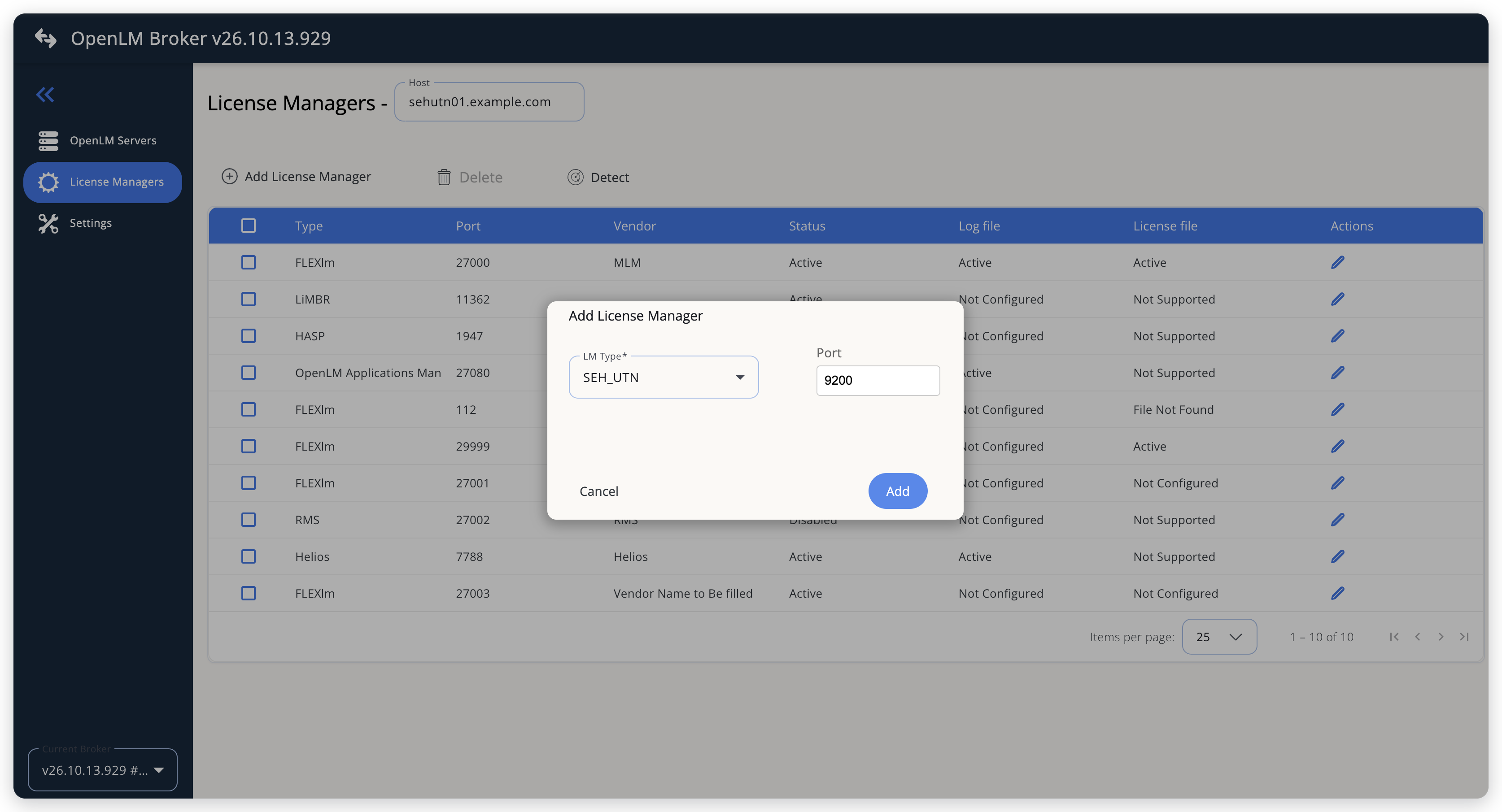 Add SEH-UTN as a license manager
-
On the Commands tab, in Executable path, enter the folder of
utnm, ending with the path separator, for exampleC:\Program Files\SEH Computertechnik GmbH\SEH UTN Manager\.Broker puts this path in front of
utnmwithout adding a separator. Leave the field empty on Linux, whereutnmis in/usr/bin. -
Select Data Inquiry and check the command.
Broker fills it in as
"utnm" -mr -p 9200 -c "getlist sehutn01.example.com", with the port and the Host that you entered. Watch interval (sec) is55and Timeout (sec) is60. Edit the command only in these cases:- The USB ports have port keys. Add
-k <port key>before-c, in both Data Inquiry and Status. - The command fails on Windows. The SEH manual writes the options for Windows as
/mr,/p,/k, and/c. Replace the dashes with slashes if Execute returns an error for the pre-filled form.
Leave Use the operating system start/stop commands off. The dongle server is hardware, and no service on the Broker machine starts or stops it.
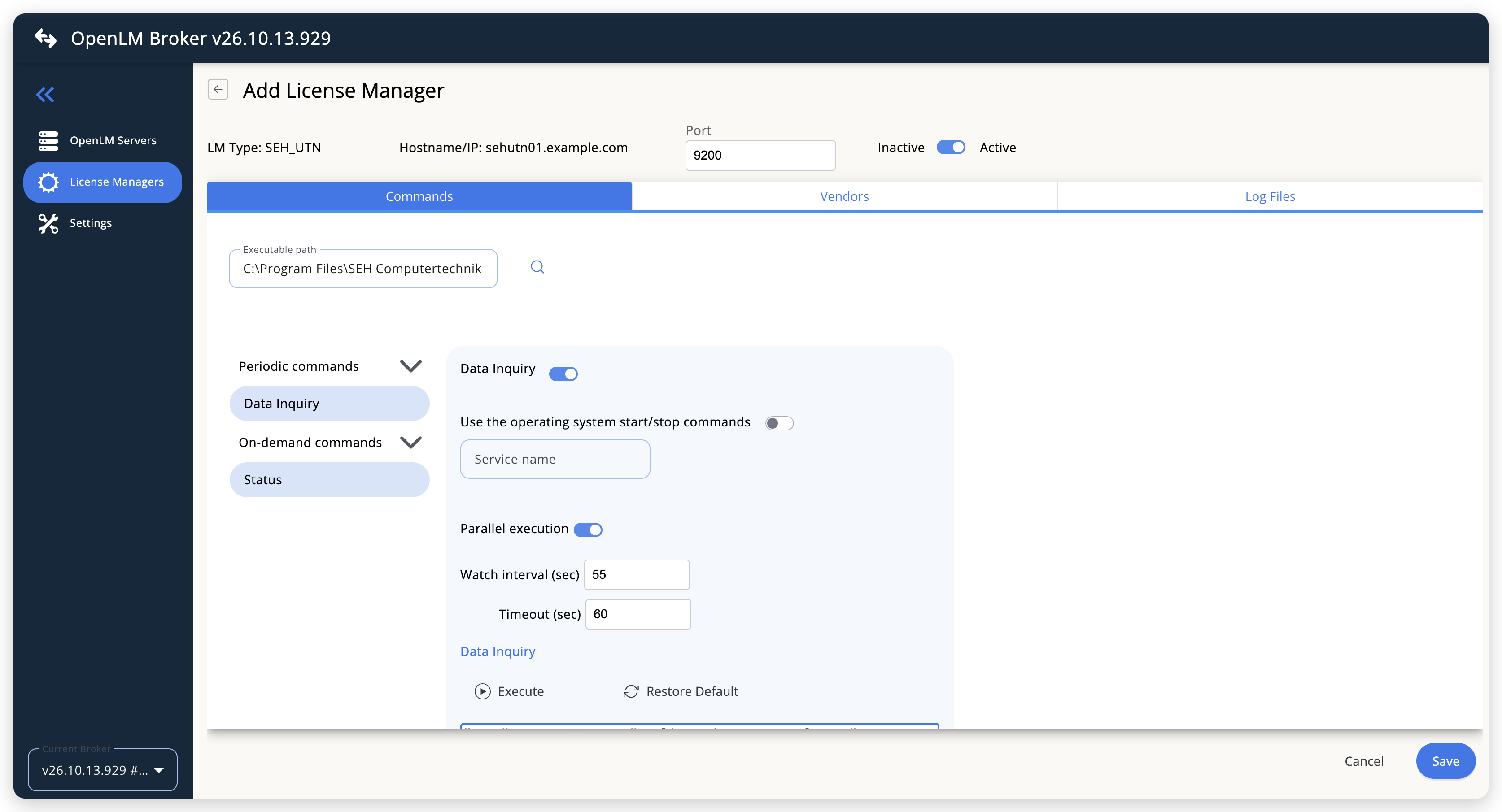 Point Broker at utnm
- The USB ports have port keys. Add
-
Leave the Vendors and Log Files tabs empty, and select Save.
Broker reports no vendor and reads no log file for SEH-UTN.
Map the utnm columns
Broker reads each line of the utnm output by column position, with a column map that it keeps in broker.xml, without a setting in the Broker web UI. The default map takes the feature name from the ninth column, counted from 0 as column 8. Versions of the UTN Manager that print the product name in the fifth column and nothing in the ninth deliver features without a name. If the license server shows no features in EasyAdmin, or features with an empty name, map the feature name to the product name column:
-
Stop the OpenLM Broker service on the Broker machine.
-
Open
broker.xml, in the Broker installation folder, in a text editor that you run as administrator. -
Find the
<port>element whose port number is the UTN port of the dongle server, and add this element inside it:<sehUtnLayout><entry><string>port</string><int>0</int></entry><entry><string>feature</string><int>4</int></entry><entry><string>status</string><int>5</int></entry><entry><string>user</string><int>6</int></entry></sehUtnLayout>The numbers are column positions counted from 0. Compare them with the output of
getliston your dongle server:4is the product name and3the vendor name,5is the status and6the user. Each license manager has its own map, so 2 dongle servers with different UTN Manager versions can use different maps on the same Broker. -
Start the OpenLM Broker service.
Saving the license manager in the Broker web UI later keeps the map. Broker uses the new map at the next data inquiry, and the features arrive under their new names after that.
OpenLM SLM configuration
Automatic configuration through EasyAdmin
If the preceding steps are complete, Broker runs the Data Inquiry command and reports SEH-UTN to OpenLM SLM. Approve the license server in EasyAdmin:
-
Open EasyAdmin (
http://<Server IP>:5015) and go to Start → Widgets → License Manager - Servers. -
Select the There are N servers pending approval link at the top of the widget.
The Administration - License Manager Servers window opens, with the pending entries at the top of the list.
-
Find the pending SEH-UTN entry, with the host name of the dongle server and the UTN port that you configured in Broker, and select the edit icon at the end of its row.
Broker reports SEH-UTN with the OpenLM Generic protocol, so its Type is OpenLM Generic.
-
Optionally rename the connection in Display name, confirm the Host Name and Port, and select APPROVE.
Manual configuration through EasyAdmin
If automatic configuration fails:
-
Go to Start → Administration → License Manager Servers.
-
Select Add LM.
-
In Display name, enter a name for the connection, for example
SEH-UTN dongle server. -
From Type, select OpenLM Generic.
Use Broker turns on.
-
In the row under Host Name, Port, and Time Zone, enter the host name and the port exactly as configured in Broker for SEH-UTN, and select a time zone.
-
Select SAVE.
Verify your configuration
- Open EasyAdmin in your browser.
- Go to Start → Widgets → License Manager - Servers.
- Confirm that the SEH-UTN license server shows the Status Up to date.
- Go to Start → Widgets → Feature Usage Status and confirm that each port name appears as a feature, with the number of ports in Quantity.
- Go to Start → Reports → License Activity, select Include Current Activity, and select Apply. Confirm that each activated port appears with the user and the IP address of the workstation that activated it.
Troubleshooting
If SEH-UTN never appears as pending in EasyAdmin, confirm that the Broker reports to OpenLM SLM: other license managers on the same Broker update in EasyAdmin.
If the license server is approved but shows no features, run the command by hand on the Broker machine, as described in Check the dongle server, and compare the result with these cases:
- Features arrive with an empty name, or not at all, while
getlistlists activated ports. The feature name column of the default column map is empty on your UTN Manager version. Map the feature name to the product name column, as described in Map the utnm columns. Encrypted connection to UTN or INU server cannot be established, which isutnmreturn value 41. The dongle server accepts only encrypted connections, and the account that runs the OpenLM Broker service has no certificate for it. Confirm thatutnmconnects when you run it from a command prompt. If it does, run the OpenLM Broker service as that Windows user, or install the certificate for all users of the machine, including the local system account.No network connection to the UTN server(return value 40) orThe DNS resolution failed(return value 43). Check Host, the UTN port, and the firewall between the Broker machine and the dongle server.- The server status in OpenLM is
No ports reported by utnm.exe.utnmprinted no ports. Check the Executable path and the command, and run it by hand. - A port appears without a user, with
Activatedas the workstation. The Broker machine itself activated that port. Move the Broker to a machine that does not consume dongle licenses.
The Broker log holds the output of every utnm call, in the logs folder of the Broker installation.
Known limitations
- Broker counts 1 license per USB port, and 1 activated port as 1 license in use. A feature's total is the number of ports with the same name, not a license count from the dongle.
- Start times are the moments Broker first sees a port change status, to the second. Sessions shorter than the watch interval of 55 seconds can be missed, and after a Broker restart every port in use starts a new session at the restart time.
- Broker does not report expiration dates, denied requests, borrowed licenses, or license allocations, and does not upload usage history. Usage in OpenLM starts when you configure the license manager.
- Broker reports no vendor for SEH-UTN.
- Host is shared by every license manager on a Broker, so 1 Broker monitors 1 dongle server. Install a Broker per dongle server.
- The column map of the
utnmoutput is set inbroker.xmlonly, not in the Broker web UI. - Multiple server redundancy is not available. Leave Is Triad Configuration unchecked in EasyAdmin.
The documentation team might draft this page using a large language model. A technical writer reviews every page and verifies it against the product before publishing it. A human makes the final decision.